






A retenir
- The hardship clause is a vital provision for restoring contractual balance in the face of unforeseen economic circumstances.
- Invoking the clause allows you to renegotiate your commercial contract when performance becomes excessively onerous for the company.
- This tailor-made contractual mechanism can override or amend Article 1195 if the parties have expressly provided for it to protect your margins.
- Drafting without a quantified threshold makes the application more uncertain and open to interpretation.
- The support of a french contract law lawyer makes the renegotiation procedure more secure for your partner.
Has your company been hit hard by a significant change in circumstances that makesperformance of the contract excessively onerous? Faced with an increase in the cost of services, the hardship clause is a contractual tool that allows you to organise renegotiation in the event of an imbalance without suffering a brutal rupture.
This article explains how this contractual mechanism works and the stages involved in renegotiating your commercial contracts. With the support of a Paris business lawyer, you will discover how to invoke the clause with expertise and use unforeseeability as astrategic lever in the event of a major economic event. By reading on, you’ll be able to protect your margin and secure your obligations in the face of the unexpected. Let’s start by checking whether your current financial risk is really covered by optimal drafting.
Financial risk: does your hardship clause really protect you?
For a company director in industry or the building and public works sector, contractual risk is nothing to sneeze at. A contract signed two years ago can become a financial pitfall if the price of raw materials doubles or if international logistics costs soar, particularly in the current geopolitical climate. The hardship clause is a contractual provision that anticipates these shocks by organising the survival of the contract rather than its breach.
However, simply mentioning it is not enough. Imprecise wording can render this tool totally ineffective when you need it most. The challenge is to transform an obligation to pay into a right to renegotiate, thereby protecting the future of your business in the face of excessively difficult contract performance.
A manufacturer is waiting for essential components for its factory in Europe.
- The event: ships can no longer pass through the Strait of Hormuz and have to round Africa via the Cape of Good Hope.
- The impact: the journey took 10 to 15 days longer. Ship operating costs double and contractual delay penalties mount up.
- Application of the hardship clause: the importer invokes the clause to request an extension of the contractual delivery deadlines and a revision of the selling price to cover additional logistical costs (demurrage, deviation costs).
3 drafting errors that render a hardship clause inapplicable
- The first fatal error lies in the tacit waiver of the theory of unforeseeability when the contract is concluded. Since the 2016 reform, Article 1195 of the Civil Code has provided a legal framework for contract renegotiation. However, many commercial contracts include a statement to the effect that each party agrees to bear the risk associated with the economic hazard. If you include this provision in your contracts or GTCs, you are severely limiting the possibility of invoking unforeseeability and thus the right to adapt the price, even in the event of catastrophic changes in circumstances.
- The second mistake concerns theimprecision of the trigger thresholds. An effective hardship clause must mathematically define what constitutes excessively onerous performance of the contract for the injured party. Without a precise percentage increase in costs, the renegotiation request is likely to get bogged down. Your partner will be able to contest the “excessive” nature of the upheaval if no financial indicator was included when the contract was drawn up.
- The third mistake is forgetting an exit procedure in the event that negotiations fail. Simply invoking the clause is not enough if the other party refuses to accept any new pricing conditions. A robust clause must provide for an explicit outcome, such as recourse to a third-party expert or termination.
The services of a contract law lawyer in Paris can help you to lock in these stages so that your company is not trapped in a contractual mechanism that has become toxic.

Negotiation strategy: how to invoke hardship to revise a contract
Invoking the hardship clause is not a declaration of war, but a request to restore fairness.
For a purchasing manager or company director, theaim is to maintain the commercial relationship while restoring profitability. Negotiations must be based on the binding force of the contract, while emphasising that the contractual balance has been upset. This is a good faith approach: you inform your partner that current economic conditions make it impossible to continue the service under the original conditions, but that you wish to find a mutually beneficial solution.
What are the legal arguments for forcing renegotiation of a contract?
The first argument must be factual: the upheaval in the economics of the contract must be documented by external data(price indices, currency rates). Hardship is a tool for preserving value. You can point out that persistence in maintaining a price that is out of step with the market could lead to default by the injured party, which would ultimately damage the continuity of the customer’s supply chain. This is thebusiness continuity argument, which is often more effective than a simple legal threat.
- Manifest imbalance: “Performance has become 40% more expensive, making the service suicidal.”
- Contractual good faith: “Article 1104 of the Civil Code requires performance in good faith, which may include an obligation of loyalty in the renegotiation.”
- Peril to operations: “Maintaining these tariffs directly threatens the sustainability of our joint supply.”
- Unidroit reference: “The fundamental balance of the contract is altered by events beyond our control.”
Hardship, unforeseeability and force majeure: comparison and choice of strategy
There is a fundamental distinction between the legal regime of unforeseeability(article 1195 of the Civil Code) and the contractual hardship clause. Whereas the law provides a default safety net, the hardship clause is a tailor-made mechanism that takes precedence over the Civil Code. It allows you to define your own rules of the game: identity of the expert, response times and limits on the judge’s power. Choosing hardship means rejecting the vagaries of the law and providing a contractual framework for revising economic conditions.
It is also common to confuse hardship with force majeure, even though their legal effects are opposite. Force majeure implies an impossibility of performance beyond the debtor’s control, such as the destruction of a factory or a total embargo, leading to the suspension or termination of the contract without liability. Conversely, hardship deals with situations whereperformance remains possible but becomes financially unbearable. It would be a fatal error to invoke force majeure simply because of a problem of cost, and this is generally rejected, save in exceptional cases, by the case law of the Cour de cassation.
The table below summarises these differences to help you choose the legal weapon best suited to your situation:
| mechanism | source and nature | key conditions | effects and power of the judge |
|---|---|---|---|
| Hardship | Contractual: tailor-made clause (often international). | Change in circumstances making performance excessively onerous. | Mandatory renegotiation in good faith. The judge intervenes only if the clause so provides. |
| Imprévision | Legal: art. 1195 of the Civil Code (French law contracts). | Unforeseeable event making performance excessively onerous. | Request for renegotiation. If unsuccessful, the judge may revise or terminate the contract. |
| Force majeure | Legal: art. 1218 of the Civil Code (universal). | Unforeseeable and irresistible event making performance impossible. | Suspension or termination of the contract. Total exemption from liability. |
If you want to maintain your commercial flows despite the crisis, drafting a hardship clause remains the most robust protection. On the other hand, if the event makes it materially impossible to provide any service, only force majeure can exonerate you from liability.
Implementation: the procedure for activating your hardship clause
Implementing a renegotiation request is a formal procedure that does not allow for approximation. Each stage, from the initial notification to the closure of discussions, must comply with the formalities laid down in the contract to avoid any forfeiture of your rights. A well-followed procedure is the best defence against future litigation before a court of appeal or an arbitration tribunal.
Procedure for triggering hardship: deadlines, evidence and formalities to be complied with
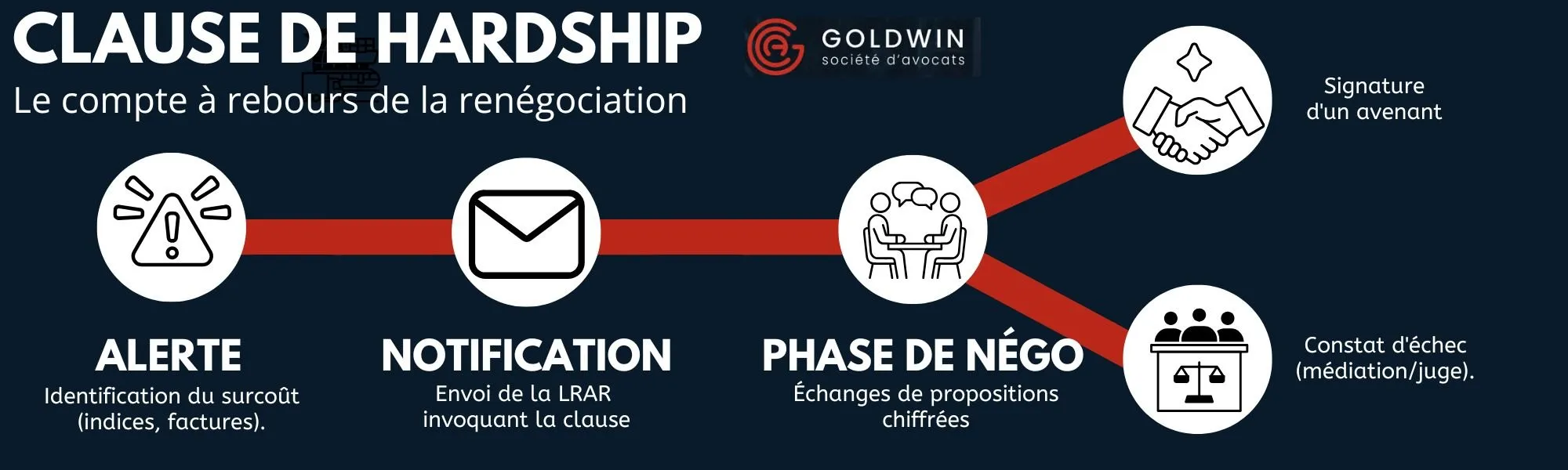
The implementation of a renegotiation clause is subject tostrict formalities designed to force dialogue while guaranteeing the legal certainty of exchanges. The process begins with detailed written notification, specifying the disruptive event, its quantified financial impact and the articles of the contract being invoked. This step is crucial because it officially triggers a discussion period(duration freely fixed by the contract), thus avoiding any indefinite contractual paralysis.
During this phase, theobligation of good faith is the central pillar: each party must participate actively and demonstrate total transparency in the communication of economic data. An obstructive attitude or categorical refusal to explore solutions (price increases, sharing of the surcharge or staggering of deliveries) may give rise to liability in cases of blatant bad faith. The ultimate objective remains the equitable adaptation of services to ensure the survival of the commercial partnership in the face of uncertainty.
Failed hardship negotiations: what recourse is available in the event of disagreement?
What happens if, after several weeks of discussion, no agreement is reached? This is where the initial wording of the hardship clause comes into its own. If the clause is “soft”, it simply obliges the parties to negotiate without any guarantee of a result, leaving them at an impasse. If it is “firm”, it often provides for the intervention of a third-party expert or mediator whose task is to propose a new contractual balance.
THE LAWYER’S ADVICE
“In the event of a deadlock, don’t rush to court. Check whether your clause allows for the intervention of an independent third-party expert. Their technical opinion often carries more weight than the threat of legal action to break the deadlock with a recalcitrant partner”.
Legal expertise: secure your contracts with a tailor-made hardship clause
In the face of increasingly volatile global markets, a robust hardship clause is a strategic investment that protects your assets and profitability over the long term. Goldwin Avocats, a Paris-based law firm, helps companies to secure their commercial relationships, both in France and internationally, by transforming the law into a genuine risk management tool.
Audit of your current clauses by an expert in contract law
A contractual auditidentifies areas of vulnerability before a crisis occurs. All too often, companies find that their clause is inapplicable the moment they try to invoke it. An expert will analyse your current contracts, terms and conditions and framework agreements to ensure that the price review and safeguard mechanisms are consistent with your operational reality.
When you call on GOLDWIN AVOCATS in Paris 16, you can be sure that your contracts are not just administrative documents, but active shields. We can help you to challenge the contracts imposed by your suppliers or to strengthen your own terms and conditions of sale. In an unpredictable economic environment, legal anticipation is the key to staying one step ahead and preventing contract performance from becoming a fatal burden for your organisation.
Frequently asked questions about the hardship clause