






A retenir
- If an established commercial relationship is broken off abruptly, the perpetrator is liable in tort, even if the contract provides for notice.
- Case law qualifies an established relationship according to its duration, regularity, and the economic dependence of the victim.
- Compensation is calculated on the basis of the gross margin lost during the notice period.
- Whether you are the victim or the perpetrator, building up a solid case of evidence directly affects the outcome of the dispute.
- In almost all situations, regular contractual termination remains the least costly option.
An order that comes to a halt, a flow of sales that disappears overnight, a business partner who breaks off without notice: the sudden termination of an established commercial relationship is one of the most destabilising situations for a company. However, not all terminations are equal in legal terms, and confusion between contractual termination and sudden termination within the meaning ofArticle L. 442-1 II of the French Commercial Code can be costly in terms of time, cost and chance of compensation.
This article sets out the legal framework applicable under French law, analyses thefinancial trade-off between the two paths, and provides concrete elements for defending your rights: from proving the existence of an established relationship to bringing an action before the competent court. Whether you are the victim or perpetrator of the break-up, you will find here the keys to acting in accordance with case law and limiting your exposure to damage.
The legal framework: contractual termination or brutal severance of commercial relations?
Contractual termination: respect for the law of the parties
Termination of a contract is based on thestrict application of the clauses laid down when the agreement was signed. In this context, contractual freedom prevails: the parties have freely determined the terms and conditions for terminating the relationship, in particular the form of the termination letter and the length of the notice period. If the terminating party complies with these provisions, it is acting in accordance with contract law.
However, this certainty is misleading if the contract is old.
Abrupt termination of commercial relations: when the law takes precedence over the contract
Article L. 442-1 II of the French Commercial Code stipulates that a person engaged in production, distribution or service activities is liable if he or she abruptly terminates an established commercial relationship, even partially. This provision is a matter of public policy in France: it applies even if the contract provides for shorter notice. A contract is deemed to have been terminated abruptly if a period of written notice commensurate with the duration of the relationship is not observed.
A distributor has been supplying a manufacturer for 8 years, accounting for 60% of its sales. Their contract provides for 1 month’s notice. The manufacturer abruptly ceases its orders within this contractual period. Despite this, L. 442-1 II applies: case law would require 8 to 10 months’ notice in this case. A contractual clause is not sufficient to override the law.
The cumulative criteria for qualifying as an established commercial relationship
For the party injured by the termination to benefit from this protection, the relationship must be established. The case law of the Cour de cassation defines this by the stability and regularity of the flow of business. It is not necessary to have a written contract; the existence ofa succession of orders over a significant period is sufficient to characterise the relationship. The longer the relationship, the more extensive the notice obligation, regardless of any clause to the contrary.
- The length of the business relationship: the longer it lasts, the more stability is presumed. A relationship lasting several years carries considerable weight.
- Regularity of orders: a continuous and predictable flow of orders demonstrates a structured, rather than occasional, collaboration.
- Economic dependence: when the turnover generated with the partner represents a significant proportion of the partner’s business.
- Dedicated investment: material, human or logistical investment made specifically to honour the commercial relationship (machines, stocks, recruitment).
- The absence of a formal framework agreement is not a barrier: case law accepts that an established relationship may exist without a written contract, provided that the facts attest to a stable and ongoing collaboration.
Costs and penalties: financial arbitration between contractual termination and sudden termination
The cost of terminating a contract: notice periods, formalities and legal certainty
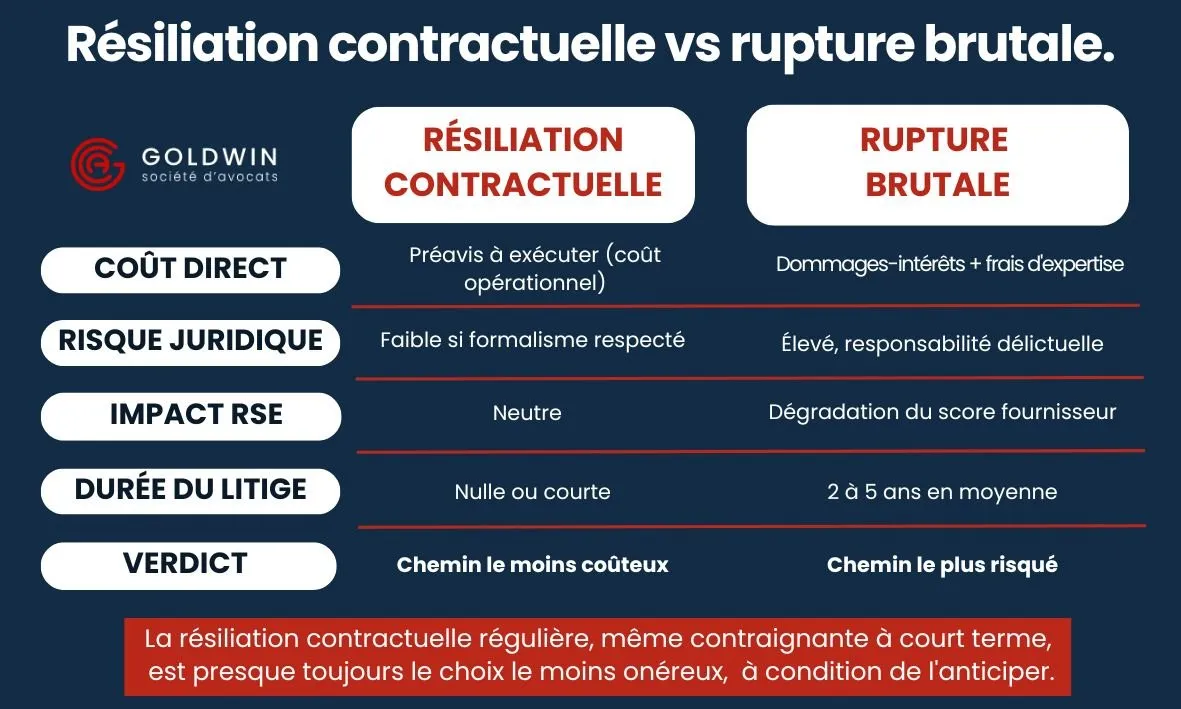
Respectful termination means maintaining performance of the contract throughout the notice period. The cost to the company is operational : orders must continue to be honoured and the supplier must continue to be paid in accordance with commercial practice. This is the price of legal peace.
Sufficient notice allows the business partner to reorganise and seek a new market outlet, thus avoiding costly litigation before the courts.
The price of brutality: penalties, damages and interest
In the event of insufficient or no notice being given, the perpetrator is liable in tort. The loss that can be compensated is calculated in relation to the gross profit that the victim would have made if the statutory notice period had been respected.
The amount can be astronomical: if the Court of Appeal considers that 12 months’ notice was required for a 10-year relationship, the compensation will cover a whole year’s lost margin, plus the costs of the expert accountant.
The reference formula used by the courts is simple: average monthly gross margin × number of months’ notice missed. The appeal courts have established ranges:
– Less than 2 years: 1 to 3 months
– 2 to 5 years: 3 to 6 months
– 5 to 10 years: 6 to 12 months
– More than 10 years: 12 to 24 months, or even longer in cases of strong economic dependence.
These benchmarks are based on case law, not regulations: each case is assessed on its own merits.
The reputational impact of a sudden break-up: CSR and commercial repercussions
In addition to financial compensation, a conviction for unfair dismissal damages the company’s image.
Distribution practices are scrutinised by social rating agencies and key accounts. Abusive termination can lead to a drop in your supplier score, effectively excluding you from certain strategic tenders.
The brutality of a relationship that is ruthlessly broken off is often perceived as a lack of commercial loyalty, damaging your future investments.
Defence strategies in the event of abrupt termination of commercial relations: proof and notification
Shadow notice: anticipating and proving a gradual abrupt termination of orders

Partial termination is a subtle practice in which the customer gradually reduces the volume of business without officially terminating the contract. This slow atrophy constitutes a breach of commercial relations if the drop is significant. (Case law generally sets a threshold of around 30%).
For the party suffering the break, it is crucial to note each change in order flow. Jurisprudence treats this situation as a sudden withdrawal if the intention to terminate is evident behind the drop in sales.
Victim of a sudden termination: how to build a solid case
Proof of the existence of a stable relationship is based on tangible elements. The company affected must gather together its invoices, email exchanges and order history over several years. These documents enable the judge to determine the duration of the commercial relationship by reference to custom. Without precise accounting proof of the loss suffered, a claim for compensation is likely to be rejected by the commercial court, even if the brutality is proven.
Checklist of essential documents to provide to your lawyer
Proof of the existence and duration of the established commercial relationship
- Signed contracts, purchase orders and framework agreements, including those for a fixed term
- Invoices classified by year for the entire history of the relationship
- Complete order history (volume, frequency, amounts) to establish the notion of an established commercial relationship
- Email exchanges attesting to regular collaboration with your co-contractor
- Commercial correspondence, minutes of meetings, records of decisions, including those involving a distributor
Proof of the abruptness of the termination
- Letter or email confirming the abruptness of the termination and setting the exact date of termination
- Any document attesting to a total or partial break in commercial flows
- Communications proving that insufficient notice was given in relation to the duration of the relationship
- Evidence that the perpetrator terminated a business relationship, even partially, without sufficient legal grounds
Putting a figure on the loss and making good the loss
- Balance sheets for the last 3 financial years to measure the impact on sales
- Income statements detailing the gross margin: compensation for the loss will be calculated on this basis
- Proof of dedicated investment, particularly in production or distribution
- Quotations or invoices from accountants hired for the case
- Any information that would allow full or partial compensation to be paid, depending on the consequences of the sudden termination of the contract.
Proof of economic dependence
- Table showing the breakdown of sales demonstrating a situation of economic dependence on the other party
- Internal documents attesting to a possible abuse of dependence on the part of the party responsible for breaking off an established commercial relationship
- Any evidence of the perpetrator’s liability within the meaning of Article L. 442-1 of the French Commercial Code
Context and confidentiality
- Any document covered by a confidentiality clause must be explicitly mentioned to your lawyer before it is sent.
- Exchanges on professional networks or by email that may establish the position of each party prior to the break-up
Breach of contract: giving notice without risking penalties
For the party initiating the breach, it is prudent to give notice by registered letter with acknowledgement of receipt. The notice period must be calculated taking into account the duration of the relationship, not forgetting any renewal periods.
If there is any doubt as to whether the notice period is long enough, it is best to stick to the legal maximum of 18 months to avoid liability. Precise drafting of the letter is your first line of defence.

Cases of exoneration: force majeure and serious misconduct
There are circumstances in which abrupt termination is permitted under the French Commercial Code. If the other party fails to fulfil a serious obligation, or in the event of force majeure, the contract may be terminated immediately without notice.
However, the definition of serious misconduct is strict and subject to the discretion of the court. A simple drop in product quality or a minor delay generally does not justify total unilateral termination without notice.
Examples of force majeure vs. serious misconduct
| FORCE MAJEURE | SERIOUS FAULT |
|---|---|
| Unforeseeable, irresistible and external event making performance impossible |
Non-performance of an essential obligation making it impossible to continue the relationship |
| Pandemic (Covid-19), admitted under strict conditions of unforeseeability and irresistibility | Breach of an exclusivity clause by obtaining supplies from a direct competitor |
| Natural disaster destroying production facilities | Diversion of customers to a competitor set up by the co-contractor |
| Embargo or international sanction legally prohibiting the continuation of the relationship | Fraud or falsification of commercial or accounting documents |
| Total fire at the premises, eliminating all production or delivery capacity | Repeated and flagrant non-payment of invoices despite formal reminders |
| Administrative decision to close or ban the business | Direct unfair competition during the performance of the contract |
After a sudden breakdown in commercial relations: recourse, continuity and reconstruction
Transferring business to a competitor and the risk of customer diversion after termination
An abrupt termination is sometimes followed by an immediate takeover of the business by a third party, often a direct competitor. If this transfer is organised by the person who terminated the contract before the end of the notice period, this may constitute an aggravating circumstance. The victim can then claim additional damage linked to the loss of opportunity and the disorganisation of his business. The Paris courts and other French jurisdictions are very firm on these circumvention practices.
An exclusive distributor of a cosmetics brand has his contract terminated without notice by the supplier. Three weeks later, a direct competitor took over the entire network of historical retailers, who had obviously been canvassed during the notice period.
The Paris Commercial Court found the third party to be an accomplice and ordered the supplier and the buyer jointly and severally to pay damages: the premature reorganisation of the distribution network constituted aggravated misconduct, which could be compensated for more than just the breach of notice period.
Requesting the forced continuation of the commercial relationship: the use of a penalty payment
In the event of imminent abrupt termination, summary proceedings can sometimes be used toobtain the forced continuation of the commercial relationship. The judge may order that deliveries or orders continue, subject to a financial penalty for each day’s delay. This solution is vital in cases of economic dependence to avoid immediate bankruptcy. It is a powerful remedy that needs to be implemented quickly with the help of a law firm specialising in business law.
Key points to bear in mind about the sudden termination of commercial relations
A poorly managed abrupt termination of a commercial relationship can cost much more than simply failing to give notice: damages, reputational damage and lasting disruption. Qualifying the established relationship, gathering evidence, giving proper notice or contesting an unfair termination – these are the levers that make all the difference in court. Given the complexity of commercial termination law, acting quickly and methodically is decisive. The lawyers at Goldwin Avocats are at your disposal to analyse your situation and define the appropriate strategy. We look forward to hearing from you.

Frequently asked questions about sudden termination of commercial relations