

A retenir
- A manager’s personal liability exposes their private assets beyond the mere share capital.
- Any management fault can lead to a heavy financial penalty, even without intent to harm.
- In the event of an insufficiency of assets, the court may order the payment of debts from your own assets.
- Specific insurance and rigorous management are essential to protect your personal assets.
Faced with a workplace accident, a tax offence or a dispute with a partner, do you really feel safe from legal action? A management decision deemed serious can break your limited liability and turn your role into a real financial danger.
We examine the critical situations in which the manager’s liability is engaged, from the notion of separable fault to the obligations relating to employee safety. Learn to run your company in compliance with every legal standard, so as to avoid personal loss and protect your assets.
Let us start by dismantling the myth that your liability is strictly limited to the amount of your contributions.
The myth of immunity: why the company does not always protect the manager’s liability
You have often been told that setting up a strong legal structure acts as a shield thanks to the principle of limited liability. Yet the line between your legal entity and your natural person is more porous than it seems as soon as a manager’s fault is identified. There is no impunity in company law: your signature binds you well beyond the mere share capital.
The corporate structure protects the investor, but it holds the management body accountable and requires it to respect the corporate interest in all circumstances.
Misconception no. 1: A manager’s liability is limited to the amount of their contributions
This is probably the most dangerous trap for a director. As a partner, your loss is limited to your investment, but your status as a company manager changes the picture. In the event of a breach of a legal or statutory obligation, the manager’s personal liability becomes unlimited. Your personal assets (house, bank accounts, personal property) may be seized to make good the damage caused to the company or to third parties.
LIMITED LIABILITY: THE SHIELD THAT CAN DISAPPEAR
Imagine the manager of a SARL in the building trade who fails to take out the compulsory ten-year construction insurance. If a construction defect occurs and the company lacks the funds to compensate the victim, the shield of “limited liability” disappears.
Why? Because failing to take out legally required insurance is treated as a management fault. The law (through the Civil Code and the Commercial Code) then allows the victim to sue the manager personally. The company is no longer the one that must pay: the individual pays from their own assets (personal accounts, real estate), because they failed in their basic duty of prudence.
Company liability vs the manager’s personal liability
Misconception no. 2: A manager’s liability is only engaged in the event of a criminal offence
Do you think you are safe as long as you do not commit tax fraud or misuse of corporate assets? Think again. Civil liability is your number one risk.
It does not require any intent to harm: simple carelessness, a negligence or a risky management decision is enough. Where criminal law punishes an offence with a fine or prison sentences, civil law orders you to pay compensation to the victim for the harm suffered.
Imagine you sign an exclusivity contract for the company without analysing the legal risks: your partners may invoke a breach of the articles of association or a lack of prudence. The causal link between your decision and the company’s financial loss will make it possible to engage your civil and criminal liability, depending on the seriousness of the facts.
Civil liability vs criminal liability of the manager:
Misconception no. 3: The company’s bankruptcy rules out the manager’s personal liability
Filing for insolvency does not wipe the slate clean, far from it. If the court finds an insufficiency of assets in compulsory liquidation, it systematically examines the management of the company. The commercial judge (Commercial Court) or the civil judge may then activate the action for liability for insufficiency of assets.
You may then be asked to personally pay all or part of the company’s debts, a frequent situation when personal bankruptcy looms.
- Artificially keeping a doomed business going to the detriment of the corporate interest.
- Failing to declare insolvency (cessation of payments) within the 45-day period (unless conciliation proceedings have been opened).
- Breaching accounting rules or using company funds for personal purposes.
Misconception no. 4: A manager’s joint liability does not exist in co-management
Do you share power with a partner? The law requires constant vigilance over the other manager’s acts. If your co-manager commits a serious personal fault and you do not express your opposition, the joint liability applies. The Commercial Chamber of the Cour de cassation regularly reminds us that silence in the face of an irregularity amounts to acceptance, thus engaging both managers of an SAS or SARL.
Legal action: how can a company manager’s liability be engaged?
Knowing where the danger comes from is essential to prevent legal risks.
Misconception no. 5: Only my partners can take me to court
Contrary to popular belief, the legal risk for a company manager does not come only from their own shareholders or from partners through the ut singuli action. In reality, the circle of potential claimants is wide and can engage the manager’s liability for any harm caused to others.
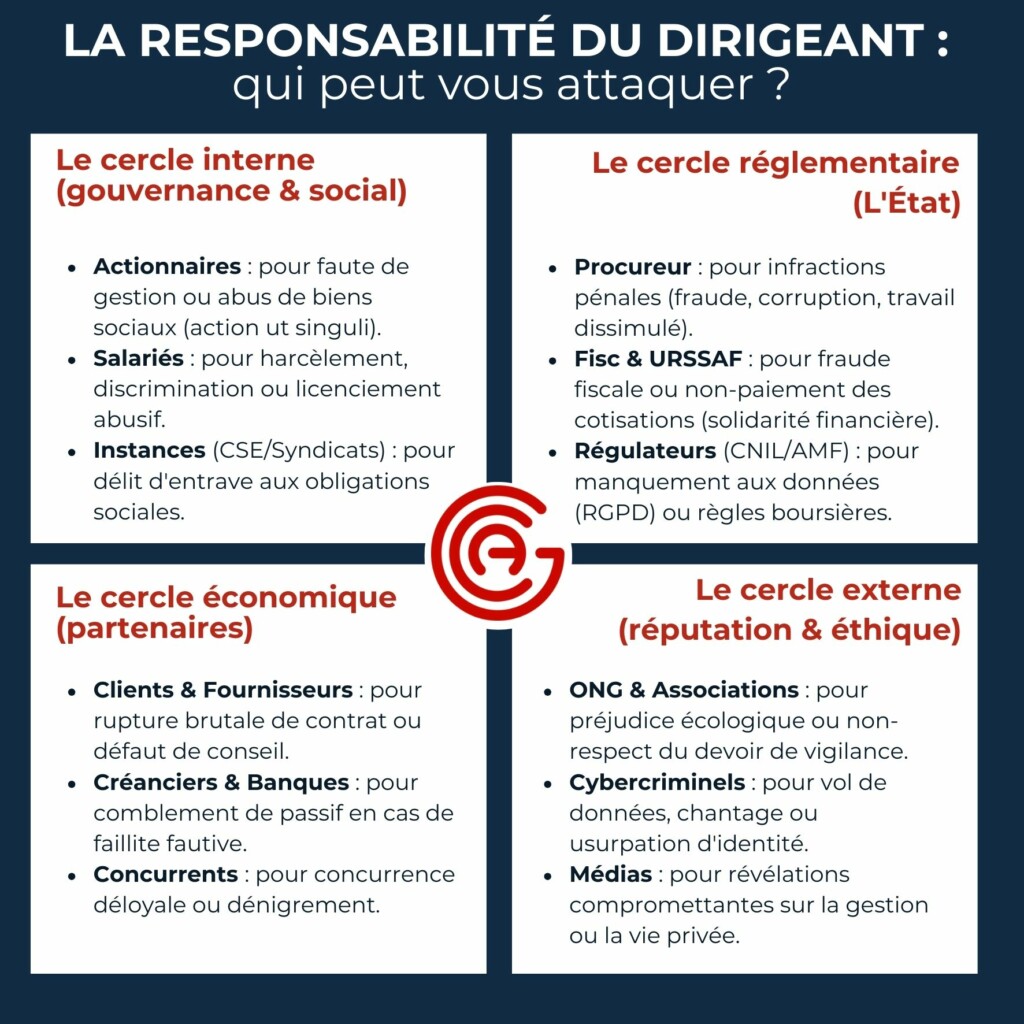
In practice, the company protects corporate officers against commercial debts, but as soon as a fault is established, this protection may fall away in favour of third parties.
From the workplace accident of its employees to tax penalties for fraud, including claims by its suppliers, no area of management is safe from legal action.
Mastering this risk with the help of expert advice is a principle of prudence that is essential for whoever runs the company. To navigate these proceedings before the commercial court or the court of appeal, the support of the business law firm GOLDWIN AVOCATS in Paris 16 is a strategic solution. They help you protect your interests and limit the consequences of being held liable.

Misconception no. 6: A de facto manager’s liability does not exist without an official appointment
The absence of a formal title does not protect you. If you genuinely run the company (signing contracts, managing assets, directing employees) without being appointed, you are a de facto manager. Criminal law and company law treat you as severely as a de jure manager. In the event of fraud or insufficiency of assets, you face the same criminal and financial penalties.
A spouse who takes all of a company’s financial decisions without a mandate can be prosecuted personally in the event of a workplace accident or bankruptcy. The Criminal Chamber of the Cour de cassation ensures that this rule is respected so that the real decision-makers do not escape the law.
To ensure full protection, separation of property is often the preferred legal arrangement, because it prevents business debts from affecting the share of the spouse’s assets.
Misconception no. 7: The company systematically covers the manager against third parties
The legal entity’s protection stops at a separable fault. If you make a mistake of exceptional seriousness, intentional and incompatible with the corporate purpose, you lose your protection. In that situation, you will have to bear the victim’s compensation alone.
This is often the case with the deliberate breach of a safety standard or a blatant act of unfair competition.
Cybersecurity and ESG issues: the new frontiers of manager liability
The world is changing, and with it the scope of the manager’s criminal liability.
Misconception no. 8: The GDPR and cybersecurity do not affect the manager’s liability
A security breach is not just an IT problem. It is a breach of the articles of association and of your duties of prudence. If a data leak occurs through negligence, your criminal and civil liability may be engaged.
The CNIL may impose a fine, and victims may claim compensation for the harm caused by your lack of prevention.
As a corporate officer, you are the guarantor of the security of intangible assets. Insufficient protection may be treated as a management fault, because it exposes the company to financial penalties of up to 4% of worldwide turnover ( Article 83 of the GDPR, paragraph 5).
Beyond the administrative fine, the lack of appropriate technical measures may, in extreme cases, lead to prosecution if an immediate risk of death or injury is established. (Criminal Code, Art. 223-1)
A lack of cyber vigilance is now becoming grounds for dismissal without compensation, because it durably undermines business continuity.
In the event of a successful cyberattack, shareholders may also turn against you if they consider that your passivity caused a fall in the value of the company.
In the event of personal data theft: contact Goldwin Avocats!
Misconception no. 9: Environmental impact is not a legal risk for the manager
Economic law now includes social and environmental responsibility. Management that ignores climate risks may be treated as a manager’s fault. If the company is convicted of environmental damage, or if its value falls through a lack of foresight, partners may invoke a breach of the corporate interest to obtain financial compensation.

Proactive defence: prevent rather than suffer
Prevention is the key to limiting your legal risks. A regular audit of how you manage the company by a business law expert lawyer in Paris is essential to protect your assets and your professional career.
Misconception no. 10: Good faith is enough to exonerate the manager before a judge
Good faith is no substitute for compliance with the Commercial Code. The judge checks whether you acted diligently. Every important decision must be the subject of a deliberation recorded in the minutes. A letter of advice or an opinion from an accountant are essential pieces of evidence to show that you sought to manage the company’s interests as well as possible.
In business law, an error of judgement is accepted, but carelessness is punished. Civil liability is engaged whenever a management fault, even an unintentional one, causes harm.
To be exonerated, the manager must prove that they acted in an informed manner. This implies constant legal monitoring and the use of technical advice for complex transactions. Without material proof of this prior reflection, the judge may find a clear failure, making the manager personally liable on their own assets.
Misconception no. 11: The company’s professional liability insurance covers the manager’s personal liability
This is a classic mistake. Professional liability insurance protects the company against damage caused to third parties. To protect your personal assets against a claim for management fault, you must take out specific liability insurance for corporate officers. It is your only real guarantee that defence costs and any compensation will be covered.
DID YOU KNOW?
Manager liability insurance covers not only damages but, above all, your defence costs (lawyers, experts), which can run to several tens of thousands of euros even before a judgment.
Misconception no. 12: The manager is no longer liable once they have left office
The risk persists after you leave your position. Civil and criminal liability actions run for several years (often 3 years in civil law, 6 years in criminal law).
Whether it is a forgery discovered late or an insufficiency of assets revealed after your departure, the past can resurface. Reviewing your former contracts and delegations therefore remains an important matter, even after handing over.
Keep a copy of your delegations of authority, shareholders’ meeting minutes and insurance contracts for at least 10 years. In the event of a late action, they are your only weapons to prove that your past acts were regular.
Conclusion: towards enlightened governance
Zero risk does not exist, but being unprepared is a fault. By mastering the contours of your civil and criminal liability and surrounding yourself with the right experts, you secure your future.
The business law firm GOLDWIN AVOCATS in Paris 16 remains your preferred partner at every stage in the life of your company.