





- The issue: an IT service provider was claiming payment for four development invoices ordered by email, without a signed contract.
- Decision: the court ruled that the emails of acceptance were conclusive evidence for July, but rejected the August invoice due to the lack of a clear agreement on the price.
- Outcome: the client owes approximately €2,700, plus interest at the statutory rate, €120 in lump-sum compensation, and €1,000 in lawyers’ fees.
Services ordered by email but not paid for: the judge rules on a case-by-case basis
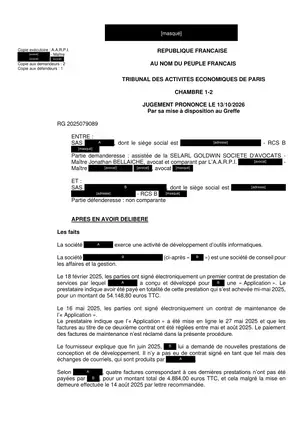
In a judgement dated 13 October 2026 (Case No. 2025079089), the Paris Commercial Court ordered the client to paythree invoices to the IT service provider, represented by Goldwin Avocats. The decision illustrates how to recover an unpaid invoice without a signed contract: clear emails are sufficient, but a vague agreement is not.
Development work commissioned by email, then left unpaid
The client stopped paying for development work that they had commissioned by simple email. In 2025, an IT company had designed and subsequently maintained an application for a consultancy firm under two contracts that had been signed and paid for in full.
At the end of June 2025, the client requested new features without signing a new contract. On 4 July, the service provider proposed a schedule of 9 man-days, i.e., 9 working days, by a developer. The client replied on 6 July: ‘That’s fine with us.’
The first invoice for July was paid, but not the following three nor the one for August. A formal notice, sent by registered post demanding payment, had no effect. When summoned to court, the client failed to appear at the hearing.
Unpaid invoice without a signed contract: the court’s ruling
The court accepted the unpaid invoice in the absence of a signed contract, as the emails proved there was an agreement regarding the service and its price. Based on Articles 1103 and 1353 of the Civil Code, it upheld the agreements of 4 and 6 July. The three remaining invoices constituted a certain, liquid and due debt, that is to say, one that was indisputable, quantified and past due.
The August invoice was rejected: the client had contested the price in writing, and an email exchange did not prove any agreement.
The service provider was awarded payment for the July invoices, but nothing for August:
| Item | Claimed | Granted |
|---|---|---|
| July invoices | approximately €2,700 | approximately €2,700 |
| August invoice | approximately €2,200 | rejected |
| Lump-sum allowances | 4 × €40 | 3 × €40 |
| Interest begins to accrue | on each due date | 20 August 2025 |
| Legal fees | €3,000 | €1,000 |
What the ruling means for a service provider or a client
A specific email of acceptance may be sufficient to justify payment for a service, even without a signed contract. Conversely, a vague acceptance or written reservations regarding the price deprive the service provider of evidence.
Before providing any service outside the scope of a contract, keep:
- the proposal specifying the scope of work and the price;
- the email from the client expressly accepting this proposal;
- the invoices relating to each accepted service;
- the formal notice sent by registered post.
Between businesses, late payment entitles the service provider to interest at an increased rate and compensation of €40 per invoice (Articles L. 441-10 and D. 441-5 of the Commercial Code).
However, each situation is assessed on a case-by-case basis.
Are you facing an unpaid invoice or a disputed order? Contact one of our commercial litigation solicitors to review your correspondence.
Related areas of expertise
Commercial and Business Law › Commercial Litigation
Frequently asked questions about unpaid bills without a contract
Yes, provided the email showsclear agreement on the service and its price. In this case, the court accepted a quotation followed by the client’s written acceptance. However, correspondence that does not specify either the content or the price, or reservations expressed in writing, is not sufficient. The judge assesses the correspondence on a case-by-case basis.
The court will rule on the matter nonetheless, but will only grant the claim if it is in order, admissible and well-founded (section 472 of the Code of Civil Procedure). The client’s absencedoes not automatically result in a finding against them: in this case, the judge examined each document and dismissed the August invoice on the grounds of a lack of evidence of an agreement.
In business-to-business transactions, three amounts are normally added to the invoice:
- interest at the European Central Bank’s rate plus 10 basis points,
- a fixed compensation of €40 per invoice
- and a portion of the solicitor’s fees.
In this case, interest accrued from the date of the formal notice, and €1,000 was awarded towards costs.