






A retenir
- The distribution contract governs the relationship between supplier and distributor, from the product to the sales territory.
- Every clause counts: duration, exclusivity, price, termination, confidentiality and commercial obligations.
- The right type of contract depends on the network involved: exclusive, selective, franchise or brand licence.
- Imprecise drafting exposes the company to litigation, abrupt termination or sanction under competition law.
- To draft a reliable contract, it’s best to consult a business lawyer before signing.
Do you know whether your current agreement complies with competition law, the rules of the Commercial Code applicable to distribution networks and, where applicable, the provisions of theMacron Act? Beyond strict legal compliance, a controlled contractual architecture is a powerful lever for ensuring your territorial coverage and accelerating your commercial growth.
This article details the essential content of a distribution agreement, from the geographical area reserved to the duration of the contract. You’ll get practical advice on how to draw up a tailor-made distribution agreement, protect your intellectual property and effectively anticipate a possible termination date. Learn how to secure every commercial relationship with the expertise of a business lawyer in Paris.
Let’s get to the heart of the matter with an explanation of the fundamental principles binding suppliers and distributors.
Definition and fundamentals: what is a distribution contract in business law?
A distribution contract is an agreement under which one party, the supplier or producer, undertakes to sell its products or services to another party, the distributor, who is responsible for reselling them to end customers. Unlike a simple one-off sales contract, it organises a commercial relationship that is ongoing and structured over time.
This tool is the driving force behind the development of a sales network, enabling a company to delegate marketing while retaining a degree of control over its brand image and sales policy.
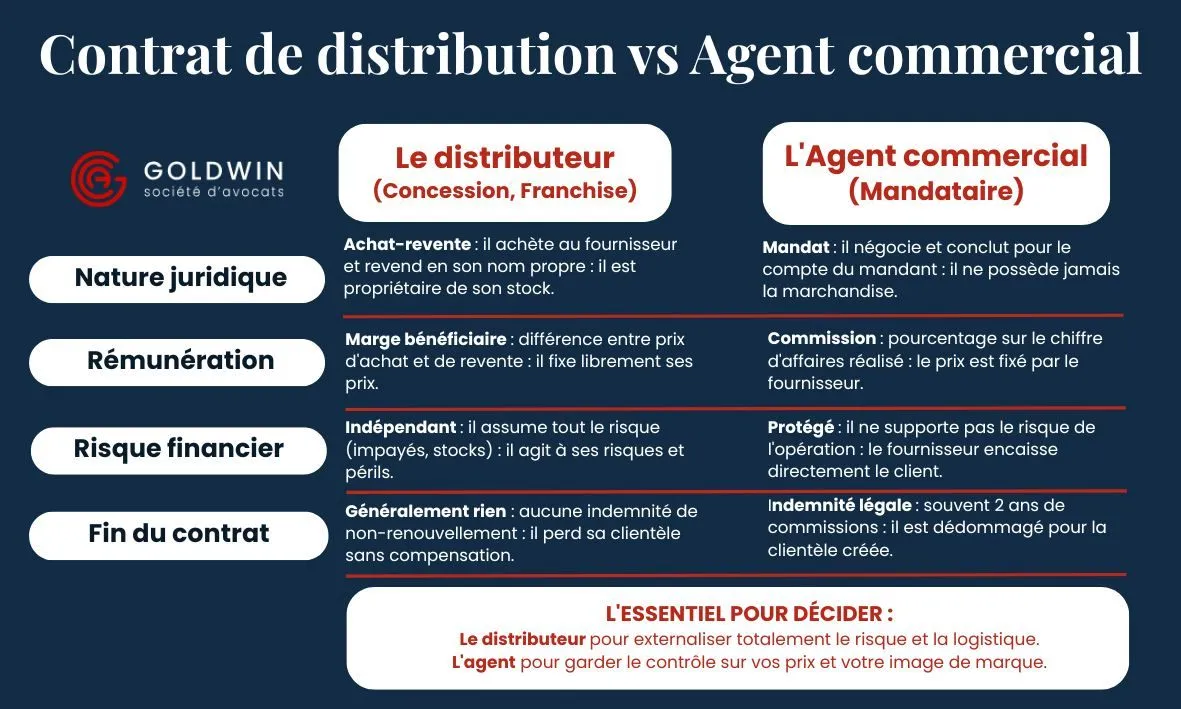
The legal nature of this agreement is hybrid, borrowing from both contract law and competition law. It should not be confused with a commercial agent’s contract, as the distributor buys the goods on its own account and assumes the financial risk of resale. This is a major distinction in business law, which has a direct impact on liability and stock management.
Distribution contract vs. commercial agent
Legal framework: sources of distribution law in France
The French legal framework is based primarily on the Commercial Code, but is largely influenced by the provisions of the Civil Code resulting from the 2016 reform of contract law. Contractual freedom prevails, but it is limited by mandatory rules designed to protect consent and the balance between professionals. In particular, the French Commercial Code governs the communication of general terms and conditions of sale(GTCS), which, when drawn up, form the sole basis for commercial negotiation.
Recent laws have introduced structural changes to make the market more fluid and protect shop operators. In particular, the Hamon Act of 2014 strengthened the system of payment periods between professionals and the associated penalties, while the Macron Act of 2015 provided a framework for certain commercial distribution network contracts, imposing their joint expiry date in certain cases and limiting post-contractual restrictions.
These texts require precise drafting, on pain of certain provisions becoming null and void or incurring heavy administrative penalties.
Why conclude a distribution contract for your network?
The organisation of a distribution network makes it possible to align commercial growth and legal protection around specific objectives:
- Territorial coverage: rapid geographical expansion without incurring massive property costs.
- Local expertise: immediate use of a sales force established in a specific area.
- Brand image: maintaining uniform standards of merchandising and customer advice.
- Security of flows: contractual framework for payments and transfer of ownership.
- Risk management: transfer of responsibility for stocks and non-payments to the partner.
- Added value: strengthening the value of the company through a structured, long-term network.
Overview and comparison of the different types of distribution contract
Choosing the right distribution model is a key decision that depends on your product, your market and the degree of control you wish to exercise. Each type of contract offers a different balance between commercial freedom and network protection.
In the retail sector, for example, the choice between a franchise and an exclusive concession will radically alter the royalties received and the support provided. In tech, licensing agreements coupled with the provision of services are often preferred. Understanding these nuances helps to optimise the profitability of each sales outlet.
Exclusive distribution or commercial concession agreements
The exclusive distribution contract grants the distributor the sole right to sell the supplier’s products in a defined geographical territory. In return for this territorial protection, the dealer generally undertakes to obtain exclusive or quasi-exclusive supplies from the producer. This is a common model in the automotive or branded furniture sectors.
This territorial exclusivity is a double-edged sword. If it motivates the distributor to invest massively to develop its area, it must be drafted carefully to avoid infringing competition law. The case law of the French Supreme Court (Cour de cassation) strictly ensures that these clauses do not disproportionately close the market to other players.
| Category | For the supplier | For the distributor |
|---|---|---|
| Strategic objective | Total control of product distribution and network stability in a specific area. | Obtain a local commercial monopoly and limit direct competition. |
| Major advantages | Simplified production planning and a long-term relationship with a single partner. | Exploitation of brand awareness and greater predictability of sales. |
| Risks and limitations | Dependence on the performance of a single player and loss of commercial flexibility. | Dependence on supplier prices, geographical limits, and risks associated with sales quotas. |
| Specific clauses | Commitment to territorial exclusivity (not to sell via other channels in the zone). | Exclusive supply agreements and non-competition clauses. |
| Legal validity | Delivery of a DIP at least 20 days before signature (if the conditions of article L.330-3 are met) | Certain exclusivity clauses, particularly supply clauses, are limited to 10 years. |
| Penalties incurred | Damages in the event of breach of territorial exclusivity. | Immediate termination of the contract in the event of sale of competing products or non-payment. |
The selective distribution contract: protecting the brand image
Selective distribution is the preferred method of distribution for luxury goods, perfumes and high-tech products.
Here, the supplier chooses his distributors not based on territory but according to precise qualitative criteria:
- prestige of the shop
- staff training
- quality of after-sales service.
In a qualitative selective distribution system, the selection criteria must be objective, uniform, and non-discriminatory.
The main aim is to preserve the brand’s image, sales environment, and positioning without unlawfully imposing resale prices.
| Category | For the supplier | For the distributor |
|---|---|---|
| Strategic objective | To preserve the brand image or technical nature of the product through a quality network. | To enhance the value of the point of sale by offering prestige or high-tech products. |
| Major benefits | Guaranteed sales environment and customer advice in line with the brand’s standards. | Relative protection against competition from retailers who do not meet the brand’s criteria. |
| Risks and limitations | Complexity of managing selection criteria and risk of litigation for refusal of approval. | High costs associated with investment in compliance with standards and ongoing staff training. |
| Specific clauses | Definition of objective criteria (location, layout, after-sales service) for entry into the network. | Strict ban on reselling products to distributors not approved by the supplier. |
| Legal validity | Need for non-discriminatory criteria and absence of a ban on passive Internet sales. | Arbitrary exclusion of a candidate meeting the criteria gives rise to liability on the part of the supplier: the refusal must be justified. |
| Penalties incurred | Risk of reclassification as an unlawful agreement if the selection is deemed arbitrary by the authorities. | Loss of approval and termination of the commercial relationship in the event of a drop in service quality. |
The franchise contract: distribution with transmission of know-how
Franchising is undoubtedly the most sophisticated form of distribution. It is based on 3 pillars:
- use of a common brand name
- the transmission of secret, substantial and identified know-how,
- and ongoing technical or commercial support.
The franchisor delegates the exploitation of its concept to an independent franchisee in exchange for an entry fee and royalties.
This is a successful model for retail and fast food. The franchise agreement must be particularly robust to protect the concept and ensure that each outlet scrupulously complies with the network’s operating procedures.
The drafting of this document requires surgical precision to avoid the subordination relationship being requalified as an employment contract by the courts.
| Category | For the franchisor | For the franchisee |
|---|---|---|
| Strategic objective | To develop a national or international network backed by the capital of independent partners. | Benefit immediately from a turnkey concept and a reputation already established in the market. |
| Major advantages | Rapid expansion of the brand and collection of royalties without bearing the risks associated with direct operation. | Access to proven expertise, ongoing support and pooled purchasing power. |
| Risks and limitations | Risk of damage to image by a negligent franchisee and threat of reclassification as an employment contract. | High start-up costs, loss of autonomy in managing the outlet and dependence on changes in the concept. |
| Specific clauses | Know-how transfer clause and right to monitor compliance with brand standards. | Obligation to pay an entry fee and periodic royalties based on sales. |
| Legal validity | Obligation to provide a complete DIP 20 days before signing the contract under the Doubin law. | Right to use the franchisor’s brand and trade name for the duration of the contract. |
| Penalties incurred | Civil liability in the event of failure to provide assistance or transmission of obsolete know-how. | Termination of the contract and prohibition on using the network’s distinctive signs in the event of serious breach. |
Brand licensing contracts
The license contract differs from other types of distribution in that it relates primarily to the exploitation of an intellectual property right.
The licensee receives authorisation to affix the licensor’s trademark to its own products or to distribute products bearing that trademark. This is a common strategy in the fashion and toy industries.
Here, the control is less about how the products are sold than about whether they comply with the graphic charter and the quality of manufacture of the goods. Brand protection is at the heart of the agreement. Poor execution can lead to a rapid decline in brand image, hence the importance of rigorous quality control clauses.
| Category | For the licensor | For the licensee |
|---|---|---|
| Strategic objective | Make a profit from an intangible asset and extend the brand’s presence without managing production or sales. | Use the reputation of a recognised brand to launch or boost the marketing of your products. |
| Major benefits | Recurring royalties and increased brand value through wider distribution. | Immediate access to a customer base that is loyal to the brand, and reduced communication costs for the launch. |
| Risks and limitations | Loss of control over product quality and risk of brand image depreciation (poor execution). | Total dependence on the validity of the brand and obligation to pay royalties even if profitability is low. |
| Specific clauses | Quality control clause, right to audit and strict definition of scope (categories). | Right to use the distinctive signs, logos and graphic charter in a given territory. |
| Legal validity | Registration of the licence (INPI or EUIPO) makes it enforceable against third parties. | Compliance with the conditions governing the duration of protection of the trademark and non-competition clauses. |
| Penalties incurred | Unilateral termination of the licence in the event of damage to the image or non-payment of royalties. | Risk of conviction for infringement if use exceeds the contractual framework. |
Are you thinking of structuring your network but not sure which legal model is the most profitable?
To secure every agreement, the expertise of a contract law lawyer in Paris is essential: GOLDWIN AVOCATS in Paris 16 can help you audit your project and choose the structure that will best protect your assets.
Hybrid distribution: the new digital and omnichannel challenges
The growth of e-commerce now requires suppliers to integrate online sales without destabilising their physical partners. Distribution law provides a framework for this cohabitation via European regulations on vertical restraints, to transform internal competition into commercial synergy.
Distribution and e-commerce: How to integrate online exclusivity?
The issue of territorial exclusivity in the digital age is a complex one. In principle, a distributor cannot be prohibited from selling on the Internet, as this is considered to be a passive sale that competition law protects. However, the supplier may regulate online sales by means of appropriate quality requirements, provided that these are not intended to prevent de facto Internet sales.
European case law, illustrated by the Coty ruling of the Court of Justice of the European Union (CJEU), confirms that a supplier of luxury goods may, under certain conditions, prohibit its authorised distributors from selling via third-party platforms (such as Amazon or eBay): this measure is deemed legitimate in order to preserve the brand’s prestigious image. This is a crucial point when it comes to controlling digital distribution.
The omnichannel distribution contract: orchestrating “Phygital.”
Omnichannel distribution involves blurring the boundaries between physical and digital points of sale. For the drafter of a distribution contract, this means including specific clauses for Click & Collect:
- Who collects the sale?
- What commission is paid to the retailer handing over the parcel?
- How are returns of goods bought online but brought back to the shop handled?
Another vital aspect concerns customer data. The contract must specify who owns the database created during online purchases and how it can be used by the various parties in compliance with the RGPD.
Poor management of these information flows can lead to major tensions within the network and legal risks for the company.
Consult the experts at GOLDWIN AVOCATS to adapt your digital clauses to the realities of your field.

Commercial strategy: how do you choose the right distribution model?
The choice of your contractual structure should be based on a pragmatic analysis of your business model and your financial capabilities: the flexibility of the model chosen is a major selection criterion for guaranteeing your company’s growth.
Advantages and disadvantages: comparative table of distribution contracts
Each model entails specific risks: concession guarantees total loyalty but limits market penetration, while selective distribution better protects the brand image and the coherence of the network but exposes you to recourse from ousted distributors if your criteria lack objectivity.
Under certain circumstances, a franchise contract may be reclassified as an employment contract if the actual conditions of performance reveal a subordinate relationship. In such cases, the company may have to pay massive social security contributions.
| Model contract | Image control | Cost of implementation | Risk of dispute/breach |
|---|---|---|---|
| Exclusive concession | ●●● | ●● | ●● |
| Selective distribution | ●●●● | ●●● | ●●● |
| Franchising | ●●●●● | ●●●● | ● |
| Brand licensing | ●● | ● | ● |
Legend: ● Low | ●● Medium | ●●● High | ●●●● Very high | ●●●●● Maximum
Selection criteria according to your sector of activity
In luxury, selective distribution is common to ensure perceived exclusivity.
In the tech and software sectors, the sales agent or authorised reseller model with a license is often preferred for the flexibility it offers.
Traditional retailing (clothing and food) is moving massively towards franchising to share property risks.
Your choice will also depend on the state of the competition. If your direct competitors are locking in the market with exclusive contracts, you may have to offer more attractive terms or a different model, such as commission affiliation, to attract the best retailers.
The target territory (France vs. international) will also influence the written form and language of the contract.
Drafting a distribution contract: key clauses to secure your relationship
Drafting a tailor-made distribution contract is the only way to effectively prevent commercial friction points. In addition to signing the contract, performance in good faith is a legal obligation sanctioned by the French courts, requiring rigorous monitoring of mutual commitments.
The pre-contractual information obligation (DIP) and the Doubin Law
The Doubin Law requires suppliers to provide a pre-contractual information document at least 20 days before signing the contract. This document must give a transparent account of the company’s history, the state of the market and the investment required to operate the store. An incomplete or misleading pre-contractual information document exposes the network to the nullity of the contract and the payment of damages.
List of compulsory information in the DIP
- Full identity of the manager and his company
- The financial health and history of the network
- The composition and development of the distribution network
- General and local market conditions.
- Contractual and financial conditions
The essential clauses of the contract
Drafting a tailor-made distribution contract is the only way to avoid friction. Here are the essential clauses to secure your commercial relationship.
Scope of the assignment
It is crucial to define precisely the purpose of the contract, the geographical territory and the territorial exclusivity.
These clauses avoid conflicts between distributors and protect the investment of those who deploy resources in their area.
Commercial and operational obligations
An exclusive supply obligation can secure the supplier’s outlets, subject to compliance with European competition law.
Performance quotas ensure the partner’s business, while merchandising standards preserve the consistency of your brand image.
Financial and logistical arrangements
Clearly set out payment terms and retention of title to protect you in the event of the distributor’s bankruptcy. The transfer of risk (Incoterms) determines the responsibility for the goods during transport.
Protection of intangible assets
The intellectual property clause governs the use of your logos and graphic identity, while the confidentiality clause protects your business secrets and know-how against unfair competition.
Life and end of the contract
Lock in the relationship through intuitu personae and lay down precise termination conditions. Providing sufficient notice avoids abrupt termination of the commercial relationship, which is heavily penalised under French law.
Performance of the contract: vigilance and liability on the part of the supplier and distributor
Throughout the term of the contract, the parties must ensure that they honor their contractual commitments.
- For the supplier, the obligations regarding availability of goods, network promotion and national advertising depend above all on the contractual stipulations.
- For the distributor, this means not disparaging the network and paying invoices on time.
Civil liability may be incurred in the event of faulty performance. For example, if a supplier delivers defective products that damage the retailer’s reputation, the latter may seek compensation.
Dispute management often begins with a written formal notice, which is a recommended first step before taking legal action before the Commercial Court.
Is a dispute starting to emerge in your network?
Our company law lawyers in the 16th arrondissement of Paris will carry out an audit of your exchanges to determine your chances of success in the event of litigation.
Termination and breach of a distribution contract: how to anticipate the end?
The end of a commercial relationship is the riskiest phase from a legal point of view. Whether it results from the end of the contract or early termination, it must be managed from the outset to protect the interests of both parties. French law, which is particularly protective, requires that sufficient notice be given to avoid being found guilty of unfair termination.
Legal termination of a distribution contract
The law distinguishes between ordinary termination, which does not require any particular reason but does require reasonable notice, and extraordinary termination. The latter occurs in the event of serious misconduct or exceptional circumstances, allowing the contract to be terminated without delay by means of a well-drafted resolutory clause.
It is essential that each breach is legally qualified to avoid the termination being deemed unfair by a judge.
Risks and penalties for unfair termination of commercial relations
Article L. 442-1 of the French Commercial Code punishes the sudden termination of an established relationship, even in the absence of a written contract. In practice, compensation is frequently assessed based on the gross margin lost during the period of notice deemed insufficient, subject to the circumstances of the case and the applicable case law. For an SME, these damages can represent considerable sums, jeopardizing the survival of the business if the end of the contract is not scrupulously documented.
Assignment and transfer of the contract
The life of a company sometimes leads to the sale of its business or goodwill. Distribution contracts often contain an “intuitu personae” or approval clause. In such cases, the supplier’s agreement is required before the contract can be transferred.
In the event of a takeover, the buyer must ensure that the supplier agrees to the transfer of the previous conditions. Conversely, if the supplier changes hands (merger-acquisition), the distributor must check whether its contract continues to apply or whether it needs to be renegotiated.
This is a key stage in guaranteeing the continuity of the network and the value of the business.
Steps involved in validating a transfer
- Audit of the initial contract: check the agreement or intuitu personae clause.
- Official notification: inform the partner of the proposed transfer in writing.
- Approval interview: introducing the buyer to the supplier.
- Signing of a transfer amendment: formalising the change of party to the contract.
The end of the distribution contract: a strategic issue to be anticipated
Anticipating the end of a partnership is just as crucial as signing it: the distribution contract must provide for every termination method to avoid abusive requalification. By securing your clauses now, you can guarantee the long-term future of your business in the face of market developments. For optimum protection of your business and your rights, seek expert advice.
Our business lawyers at GOLDWIN AVOCATS will be happy to provide you with a personalised consultation. Contact our firm to arrange a consultation.
Frequently asked questions about distribution contracts