





A retenir
- A customs seizure may involve any goods suspected of infringement, counterfeiting or non-compliance at the border.
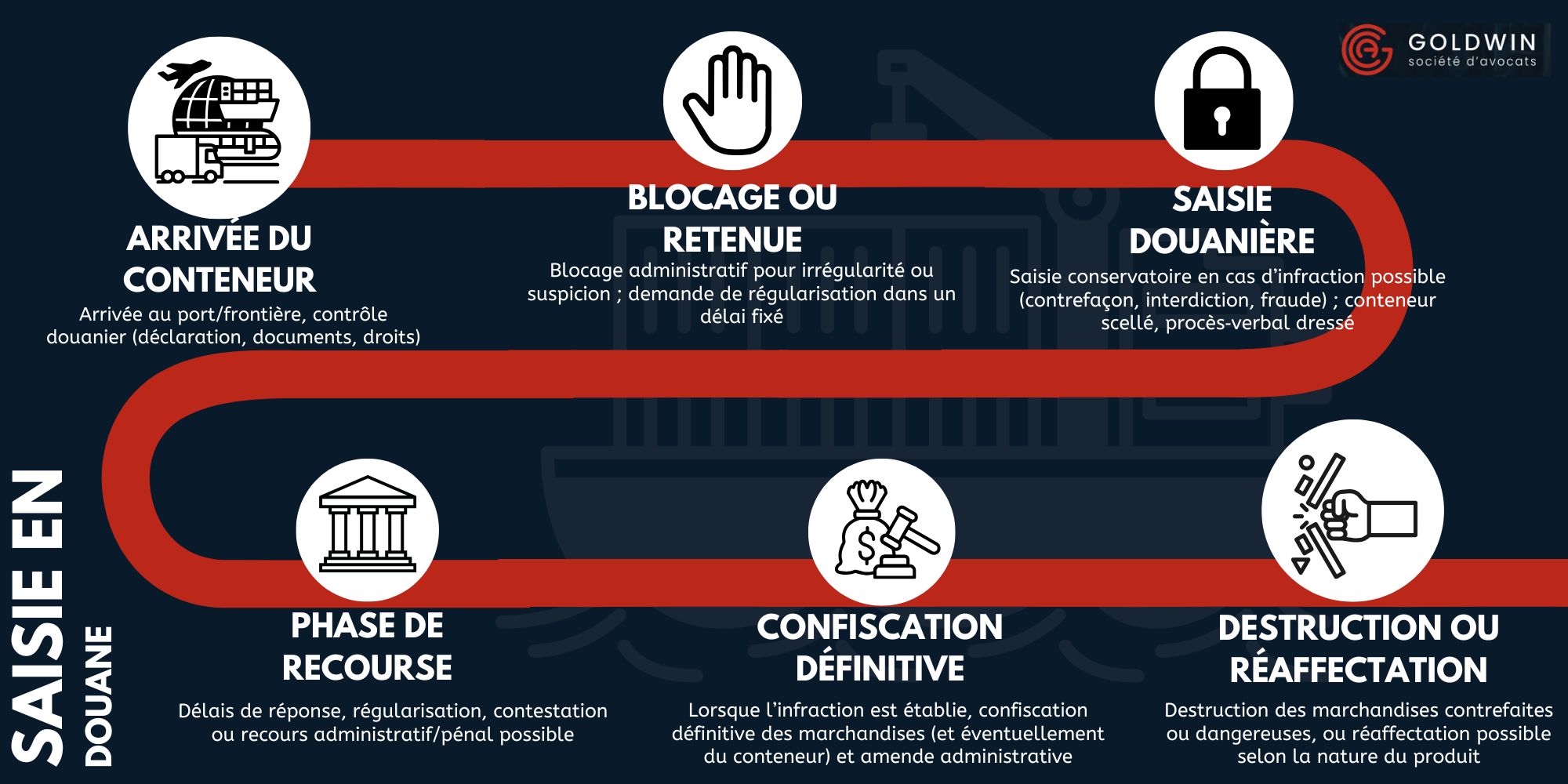
- Detention, seizure, report, time limit, appeal: each stage of the customs procedure has immediate legal consequences.
- In France, inaction after a customs inspection weakens the case and increases the risk of a fine or prosecution.
- Whether you area company, a private individual, an importer or a haulier, anyone can be affected by a customs inspection.
- In the event of an unfounded seizure, it is sometimes possible to obtain the return of goods and claim compensation with the help of a customs lawyer in Paris..
When goods are blocked at the border, in a warehouse under surveillance, at the port of Marseille, at Roissy or at a transit site in France, people are often dumbfounded. However, when faced with a customs seizure, detention or interception by the French customs authorities,inaction is rarely a good strategy. Every day counts: an official report, a request for information, a missing document, a question of conformity, counterfeiting, intellectual property, value, code or regulation can tip the case towards a more serious procedure, with a fine, destruction, prosecution or refused return.
In this type of customs inspection, it’s not just a technical or logistical problem. It’s about the law, evidence, deadlines, penalties and appeals. Whether you are a company, a private individual, the owner of the goods, a rights-holder or simply involved in transport, your initial reaction has a direct impact on what happens next: comments on the report, challenge, compliance, amicable or legal action, even referral to the court or intervention by the public prosecutor.
In this article, we review the main reflexes to adopt, the risks to identify and the legal levers to act quickly, usefully and contest the seizure or challenge a decision when justified.
Customs seizure procedure: operation and detection tools
Legal definition of customs seizure and legal framework (Customs Code)
Customs seizure is a measure by which customs officers seize items liable to confiscation and documents relevant to the proceedings, under the conditions set out in the Customs Code. Unlike a simple check, a seizure is carried out when a customs offence is established or strongly suspected. It is based in particular on the provisions of the Customs Code, which allow for the seizure of items liable to confiscation, documents relating to the fraud and certain goods useful in the proceedings.
It is crucial for SME managers and private individuals to distinguish between seizure and customs detention.
- Detention is a temporary precautionary measure, limited in time (10 working days, or 3 days for perishable goods), enabling the authorities to check compliance or seek the opinion of an intellectual property right holder.
- The seizure initiates a customs procedure that may lead, depending on the case, to a return, a settlement, a refusal to return or legal proceedings.
The different grounds for seizure: from administrative error to counterfeiting
Customs seizures can affect a wide range of products, from luxury goods to industrial components. A common reason is counterfeiting, where goods suspected of infringing a trademark are intercepted at the border. A large proportion of seizures are the result of a technical error: the wrong type of tariff, an undervalued customs value or the absence of a document certifying compliance with European Union standards (CE marking).
Customs offences do not always require fraudulent intent on the part of the importer. Simple negligence in logistics management or in filling in transport documents can lead to interception. Whether the item is a prohibited good or simply a misdeclared product, the consequences for the company are immediate: stock shortages, loss of value and even damage to reputation.
| Reason for seizure | Perceived seriousness | Main risk |
|---|---|---|
| Counterfeiting | Very high | Confiscation, heavy fine, criminal prosecution |
| Error of value | Moderate | Adjustment of customs duties, fine |
| EC non-compliance | High | Goods blocked, refused entry to market, brought into compliance or even destroyed |
| Trafficking in prohibited products | Maximum | Police custody, prison, record fines |
AI targeting: how customs detects your goods
The French customs administration has modernised its control methods thanks to the Direction Nationale du Renseignement et des Enquêtes Douanières (DNRED). Today, targeting is no longer done at random. Customs uses risk analysis, intelligence and algorithms includingartificial intelligence tools to analyse massive international transit data and improve the targeting of controls. These tools detect statistical anomalies, such as an abnormally low transport price or a high-risk geographical origin for certain types of product.
This“risk scoring” enables agents to intervene surgically on specific packages even before they arrive in France. For importers, this means that the strengthening of targeting and control tools increases the risk of anomalies and irregularities being detected. Technology at the service of public service makes it essential to be absolutely rigorous in the preparation of each import file.
Need an immediate expert opinion?
If your cargo is intercepted, contact a transport lawyer in Paris immediately to analyse the validity of the check.
Consequences of a customs seizure: the risks of inaction
Time limits for detention and timetable for the seizure procedure
Time is an economic operator’s worst enemy when dealing with French customs. In intellectual property matters, when goods are detained, the right holder has 10 working days (3 days for perishable goods) to take legal action or request confiscation. If you don’t react quickly, your room for manoeuvre is reduced and costs increase.
If the offence is a customs offence, the official report is forwarded to the public prosecutor. The inertia of the owner of the goods makes it easier to impose penalties. Every day that goes by without a complaint or request for action increases storage costs and reduces the chances of obtaining an amicable or judicial release.
The critical case of e-commerce and dropshipping
The e-commerce sector is particularly exposed to the risk of customs seizure for counterfeiting or non-compliance. Many dropshipping sellers mistakenly believe that they are exempt from liability because they are merely a link between the foreign supplier and the customer in France. However, depending on the facts, the importer, the declarant, the customs representative orother people involved in the operation or interested in the fraud may be liable.
If a massive flow of contentious products is intercepted, the merchant site may find its activity paralysed. The financial consequences are doubled by a loss of confidence on the part of customers and payment platforms. E-commerce operators and digital intermediaries are subject to compliance obligations stemming in particular from the European regulation on digital services (DSA) and, in France, from the SREN law.
Financial and criminal consequences: more than just the loss of the product
The outright loss of the goods is just the tip of the iceberg. A customs seizure can result in a tax fine of up to several times the value of the item seized.
To this must be added the costs of destruction and storage at customs, which are borne by the person detained or the company.
From a criminal point of view, an official report of a customs offence can lead to police custody and an appearance in court. The company’s reputation may be permanently affected on national territory, which will limit its transit capacity in the future. The stakes are therefore not just financial, but affect the legal survival of the business entity.
Legal remedies and solutions for recovering seized goods
What are your rights in the event of a customs seizure?
The law provides fundamental guarantees to protect users against unfounded or disproportionate seizures. Depending on the procedure used, you must be informed of the charges against you and may be entitled to theassistance of a lawyer, particularly in the event of a hearing or a customs measure likely to result in a prison sentence.
Compliance with the procedure by the officers is a condition for the validity of the seizure. Any failure to comply with the provisions of the Code of Criminal Procedure or the Customs Code may give rise to a claim for compensation or the cancellation of the confiscation measure. It is therefore essential to have each document analysed by a professional to identifyany formal defects.
- Right of reservation: you may refuse to sign the statement of offence or add specific comments.
- Right to a lawyer: you can request the assistance of a lawyer from the first customs hearing.
- Right to expert appraisal: you can submit documents, analyses and supporting evidence to discuss the infringing nature of the goods.
- Right to read: the officer must let you read the entire document before signing.
- Right to copy: you must leave with a copy of each document signed.
Customs settlement: how to negotiate a fine and avoid going to court
Settlement is a common and effective practice in French customs law. It enables the customs authorities and the offender to reach an amicable settlement to end the prosecution. In exchange for the payment of an agreed sum, the public prosecution is extinguished, which avoids the need to go before the criminal court and have a conviction entered in the criminal record.
Negotiating a settlement requires detailed knowledge of the case law and internal scales of the regional directorate concerned. A customs lawyer will be able to put forward your good faith and extenuating circumstances to obtain a substantial reduction in the initial fine. This is often the most rational course of action for a company wishing to limit the financial impact of a compliance error.
| Aspect | Judicial | Amiable settlement |
|---|---|---|
| Duration | Long (several months / years) | Rapid (a few weeks) |
| Cost | High legal fees, risk of litigation | Negotiated fine, saves time |
| Criminal record | Risk of conviction | No criminal record |
| Purpose | Decision by a judge | Contractual agreement |
How to contest and obtain the release of the seizure?
The standard procedure for recovering your goods is to apply for the seizure to be released. If the authorities refuse to return the goods amicably, legal action may be taken in court. This approach is particularly appropriate in cases of unfounded seizure, for example when goods are unfairly suspected of being counterfeit even though they are genuine.
Article 323-11 of the Customs Code provides a framework for appeals relating to the return or non-return of seized objects. By referring the matter to the public prosecutor or examining magistrate, it is possible to request the return of goods if their retention is no longer necessary to establish the truth.
A solid case, including proof of purchase and technical certification, is the key to convincing the judicial authorities.
Goods blocked? Don’t let the situation escalate. To find out how to act in the event of counterfeiting or a trademark dispute, contact our firm for a situation audit.
Preventing customs risks: securing your imports and exports
Customs compliance audit: anticipate to avoid seizure
The best defence against seizure is flawless preparation upstream of transport. A compliance audit can identify the areas of risk in your supply chain. It involves checking that each product has the right customs code, that its origin is documented in accordance with European Union rules and that its declared value complies with WTO standards.
This preventive work transforms customs from a threat into a transit partner. By submitting a Binding Tariff Information (BTI) request, you obtain a written guarantee from the authorities as to the classification of your goods. In this way, the practice of auditing drastically reduces the risk of interception at borders. However, it does not in itself rule out any customs checks or measures on other grounds.
- Checking the tariff nomenclature (HS code).
- Validation of proof of origin (free trade agreements).
- Rigorous calculation of customs value (including transport costs).
- Check certificates of conformity and specific standards.
- Secure digital archiving of the entire documentary package.
Managing relations with intellectual property rights holders
For companies dealing in branded products, the relationship with rights holders is a strategic issue. French customs work closely with companies in the fight against counterfeiting. As a legitimate importer, you need to be able to provide instant proof of licence or pro forma invoices validated by the brand.
Filing a request for action with the Customs Department enables brand owners to protect their rights, but it can also have an impact on bona fide distributors in the event of miscommunication. Maintaining a transparent link and impeccable traceability documents is the only way to avoid an original product being confused with a counterfeit item during a routine check.
Customs seizure is a test of strength where every decision counts. By acting from the very first hours of detention, you protect not only your goods but also the financial future of your business.
Why call on Goldwin Avocats in the event of a customs seizure?
Goldwin Avoc ats is an expert in customs law and is involved at every stage of a seizure procedure: analysis of the official report, preparation of the restitution file, negotiation of a settlement with the authorities, and litigation before the competent courts. Our expertise enables us to identify procedural flaws quickly, build a solid case and defend your interests in court and with customs.
Whether you are an individual, an importer, an exporter or a carrier, the firm can provide you with a tailor-made strategy. Contact Goldwin Avocats for an initial consultation to assess your remedies and take action within the deadline.

Frequently asked questions about customs seizure
- Cash may be held for up to 30 days. Beyond that time, cash may be deposited with judicial authorisation, in principle for up to 12 months. These measures are in line with the Customs Code and recent anti-money laundering rules.
- In the case of goods, the customs authorities have 30 days from receipt of a request from the interested party, or automatically on expiry of a period of 2 months from the date of seizure, to rule on restitution where ownership is not seriously disputed. If restitution is not requested or decided in accordance with the conditions set out inarticle 323-11, the unreturned items may become the property of the State.