






A retenir
- A fast-track procedure, but a demanding one: the CRPC makes it possible to propose and approve a sentence in a single sequence, provided that the accused fully admits the facts. Fast, yes, but the consequences are severe and immediate.
- Strict legal framework: it applies only to offences admitted by an adult, with compulsory assistance of a lawyer and final review by a judge. Crimes, minors and several categories of offence (press, politics, certain sexual assaults) are excluded.
- The defendant has three choices: accept the sentence, refuse it or ask for a delay. Acceptance is tantamount to accepting a conviction entered on the criminal record, even if it can be adjusted at a later date.
- The central role of the lawyer: he or she secures the procedure, verifies the legality of the proposal, negotiates the sentence and protects against errors of assessment or pressure from the prosecution.
- Strategic alternative to trial: useful for avoiding an immediate appearance, limiting the risk of detention and often obtaining a lower sentence, but unsuitable if the admission of the facts is incomplete or contested.
This is a unique procedure in the French Code of Criminal Procedure: an appearance based on prior acknowledgement of guilt, known as CRPC, combines in a single day the proposed sentence, theapproval hearing and sometimes even the final decision. The accused, assisted by his or her lawyer, is summoned before the public prosecutor to admit the charges. The public prosecutor proposes a sentence, often less than half of that incurred: a fine, suspended sentence, or imprisonment with special arrangements. The criminal court judge, hearing the case for approval, verifies the legality of the agreement before handing down an order.
Fast and straightforward, but fraught with legal consequences, the CRPC can be as appealing as it is worrying.
Should we accept this proposal or reject it as a conventional trial? Each case, each offence, each person involved reveals a different facet of this French-style guilty plea.
Definition and legal framework of the CRPC procedure
What is the CRPC and what is the purpose of this criminal procedure?
Appearance on preliminary recognition of guilt, or CRPC, is a simplified criminal procedure that allows a defendant to be tried without going through a traditional hearing. When an individual admits the charges against him or her, the public prosecutor can propose a sentence that complies with criminal law and constitutional principles.
This system, governed by articles 495-7 to 495-16 of the Code of Criminal Procedure, is based on voluntary acknowledgement of the facts and the supervision of a magistrate. The president of the judicial court, or the delegated judge, ensures that the person concerned fully understands the scope of the decision before it is implemented.
This procedure, also known as a guilty plea, is designed for clients who are confronted with an offence to which they admit responsibility. Accompanied by an experienced CRPC lawyer, you can avoid mistakes, adjust the sentence and protect your rights in a sometimes intimidating legal environment.
Origin and development of the guilty plea in France
The CRPC was introduced by the Perben II Act of 9 March 2004. Inspired by theAmerican“plea bargaining” system, it introduced the principle of pleading guilty in court, which had long been considered alien to our legal culture. This innovation marked a major step forward in the modernisation of the public justice service.
Over the years, the procedure has been extended to a large number of offences, including driving without a licence, drug use, simple theft and even minor bodily harm. However, it is still not available for crimes, sexual assaults or cases involving minors.
Today, the CRPC has become a central tool of the judicial service, halfway between speed and procedural rigour. It responds to the need for efficiency, while retaining the control of the criminal court judge and the public prosecutor.
Conditions for initiating an appearance on preliminary recognition of guilt
What offences are covered by the CRPC?
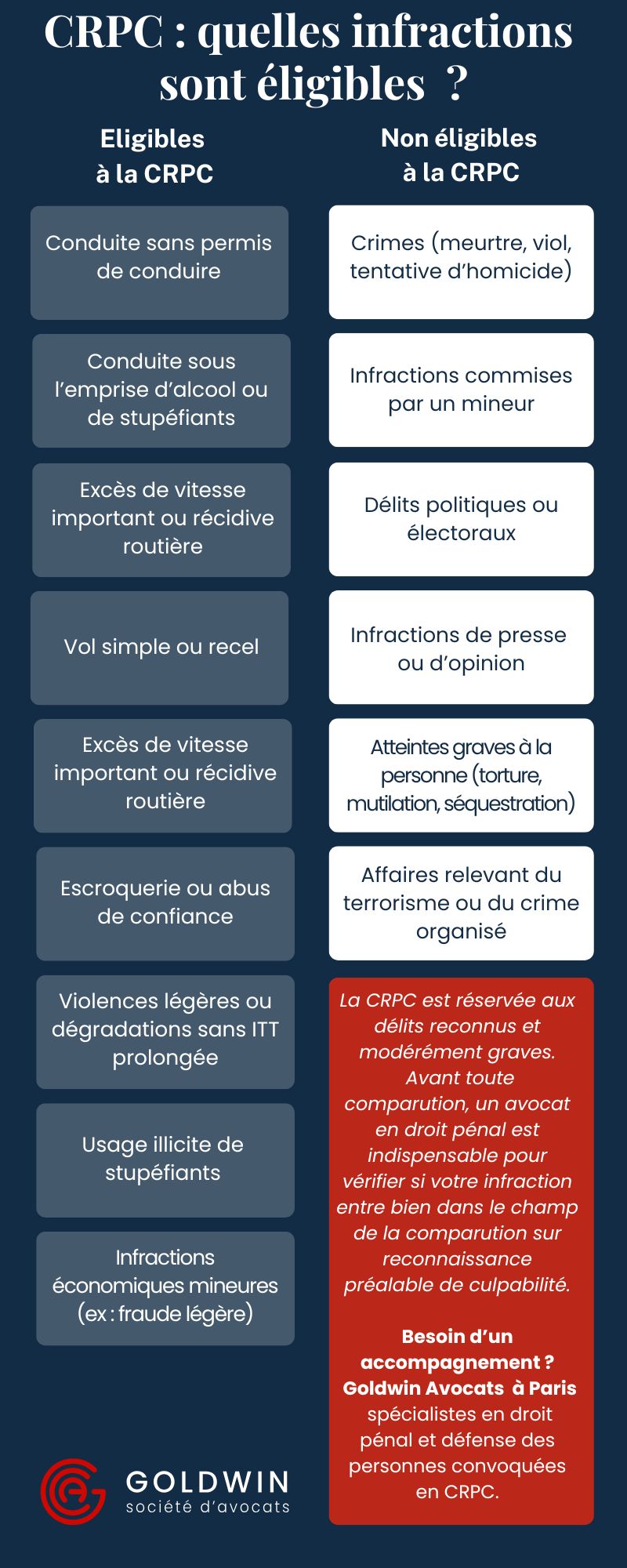
The CRPC can be applied to most offences, with the exception of press offences, political offences, certain manslaughter offences, certain sexual assaults and offences committed by minors. These include offences such as driving without a licence, intentional violence, simple theft andfraud. Certain road traffic offences are also among the most frequent cases.
However, the CRPC is not available for felonies, press offences, political offences, certain manslaughter offences, certain sexual assaults and offences committed by minors. These cases come under the jurisdiction of the criminal court or the assize court.
The public prosecutor chooses to use the CRPC depending on the seriousness of the offence and the personality of the defendant. This is a selective procedure, suitable for situations where there is a clear admission of the facts.
Who can be summoned before the public prosecutor for a CRPC?
Any adult defendant who admits the alleged offence may be summoned. The summons is issued by the public prosecutor and mentionsthe date, place and purpose of the appearance on preliminary recognition of guilt.
A criminal lawyer must be present. Failing this, a court-appointed lawyer is appointed. The lawyer verifies the legality of the procedure, advises the accused on the strategy to adopt and helps him or her to understand the implications of an accepted sentence.
The client must also be informed of his or her rights: to refuse the proposal, to request a delay, or to apply for a judicial review in the event of detention. A lawyer can help to ensure that an ill-considered decision does not lead to the sentence being overturned at a later date.
Criteria for the validity of an admission of guilt
To be valid, the admission of guilt must be free and complete.Article 495-8 of the Code of Criminal Procedure requires the presence of the CRPC lawyer at this stage. The judge must ensure that the defendant acts without pressure and that he or she understands the nature of the offence admitted.
If the acknowledgement of the facts is partial or doubtful, the CRPC is not possible: the case is referred back to the criminal court.
The delegated judge checks the identity of the person, the consistency of the case file and the sincerity of the approach. If there is any doubt, the CRPC criminal proceedings are suspended and referred back to the criminal court. This rigorous control protects defendants and preserves the principles of the Constitution.
The full CRPC procedure
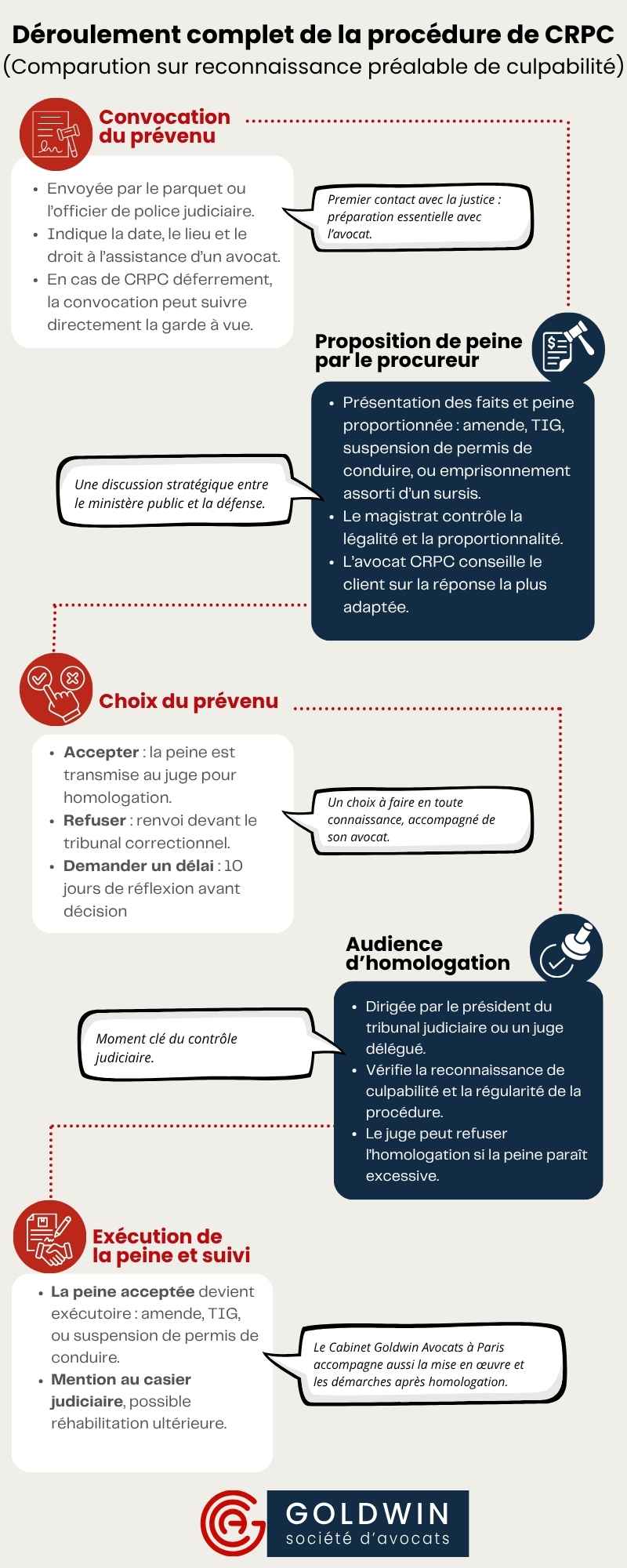
Summoning of the accused by the public prosecutor
The procedure begins with a summons sent to the defendant by the public prosecutor. This letter sets the date and place of the appearance and informs the accused of his or her right to the assistance of a lawyer. In some cases, the CRPC déferrement allows the accused to be summoned immediately after police custody, to avoid unnecessary pre-trial detention.
Thelawyer prepares the case file, examines the evidence and advises the client on the best course of action to take. This preparation has a direct impact on the rest of the procedure.
If you are summoned to appear for a CRPC, Goldwin Avocats in Paris will assist you from the moment you receive the letter. Our lawyers will help you understand the procedure, anticipate the prosecutor’s questions and defend your rights from the outset.
The prosecutor’s proposed sentence
At the appearance on preliminary recognition of guilt, the public prosecutor presents the facts of the case and proposes a sentence commensurate with the offence. This penalty may be a fine, a driving licence suspension, community service or a suspended prison sentence.
The magistrate checks that the sentence complies with the law and does not exceed half of the sentence incurred. The customer may ask questions, request clarification of certain points or contest the classification of theoffence.
The lawyer has a decisive role to play: he or she analyses the proposal, assesses its consistency and ensures that it is implemented in accordance with criminal law. The dialogue between the prosecution and the defence often determines the final outcome.
Agreement, refusal or request for a delay by the defendant
The accused has three options: accept, refuse or request a delay. If he accepts, the sentence is sent for homologation. If he refuses, the case is referred to the president of the judicial court for judgment. The accused may also request a delay in order to consult his criminal lawyer before any decision is taken.
This choice must be informed. If a sentence is accepted, the defendant will be held responsible and will be deemed to have definitively acknowledged his guilt. The lawyer must explain the consequences for the criminal record and any possibility of rehabilitation.
The lawyers at Goldwin Avocats advise each client on whether it is preferable to plead guilty or not guilty, depending on the situation and the evidence available.
The homologation hearing before the criminal court judge
Once the sentence has been accepted, the case is referred to the Criminal Court judge for approval. The hearing, presided over by a delegated magistrate, enables the regularity of the procedure and the proportionality of the sentence to be verified.
The presiding judge also checks that the person has admitted the facts without coercion and that the proposed penalty complies with the law. The defence counsel may make brief observations.
The judge may refuse to approve the sentence if he considers it excessive or if the admission is unclear. In this case, the procedure is cancelled and the case referred back to the criminal court.
After homologation: enforcement of the sentence and legal proceedings
Once the decision has been accepted and approved, the sentence becomes enforceable immediately. Enforcement varies according to the nature of the penalty: payment of a fine, suspension of a driving licence or community service.
The conviction is entered in the criminal record, but may be pardoned at a later date. TheCRPC lawyer can also request a partial annulment or an adjustment if there are difficulties in enforcing the sentence.
Goldwin Avocats in Paris also assists with the implementation of the sentence once it has been approved, and anticipates any administrative or professional consequences.
The rights and guarantees of the accused and the victim during the CRPC
The role of the lawyer in the CRPC procedure
TheCRPC lawyer plays an essential role in the client’s defence. His presence is compulsory, whether he is an independent criminal lawyer or a court-appointed lawyer. He ensures that the procedure complies with the law and the constitutional principles of the right to a defence. He or she intervenes as soon as the defendant is summoned, prepares the case file and assists the defendant at the hearing. He also checks that the penalty accepted complies with the law and is proportionate to the offence.
High-quality legal support can often prevent irreversible mistakes.
Goldwin Avocats in Paris offers a comprehensive service, from the first summons to the implementation of the sentence, to ensure that your rights are respected at every stage.
The rights of the accused during the court appearance
The accused retains all his rights to a defence during the proceedings: to be assisted by a lawyer, to consult the case file, to request a delay or to refuse the proposed sentence.
Article 495-9 of the Code of Criminal Procedure protects this right to time to reflect, which is essential in a context of stress and uncertainty.
The defendant may also request a judicial review or a deferred hearing, particularly if he or she disputes certain aspects of his or her identity or the charges brought against him or her.
The procedure is therefore not automatic: it only takes effect after free and informed consent has been obtained from the magistrate in charge of the case.
The victim’s rights in the CRPC procedure
Victims continue to play an important role in criminal proceedings under the CRPC. Victims may be informed of the court appearance, bring a civil action and submit a claim for compensation. The president of the judicial court or the delegated judge ensures that the victim’s interests are respected, particularly in terms of financial or moral compensation. The public prosecutor may also intervene to defend the victim’s rights, in accordance with the Perben II Act.
The role of thevictim’s lawyer is complementary here: he or she presents evidence of the damage and ensures that the final decision does not overlook compensation.
Advantages, limitations and legal advantages of the CRPC
The advantages of the CRPC for the defendant and the prosecutor
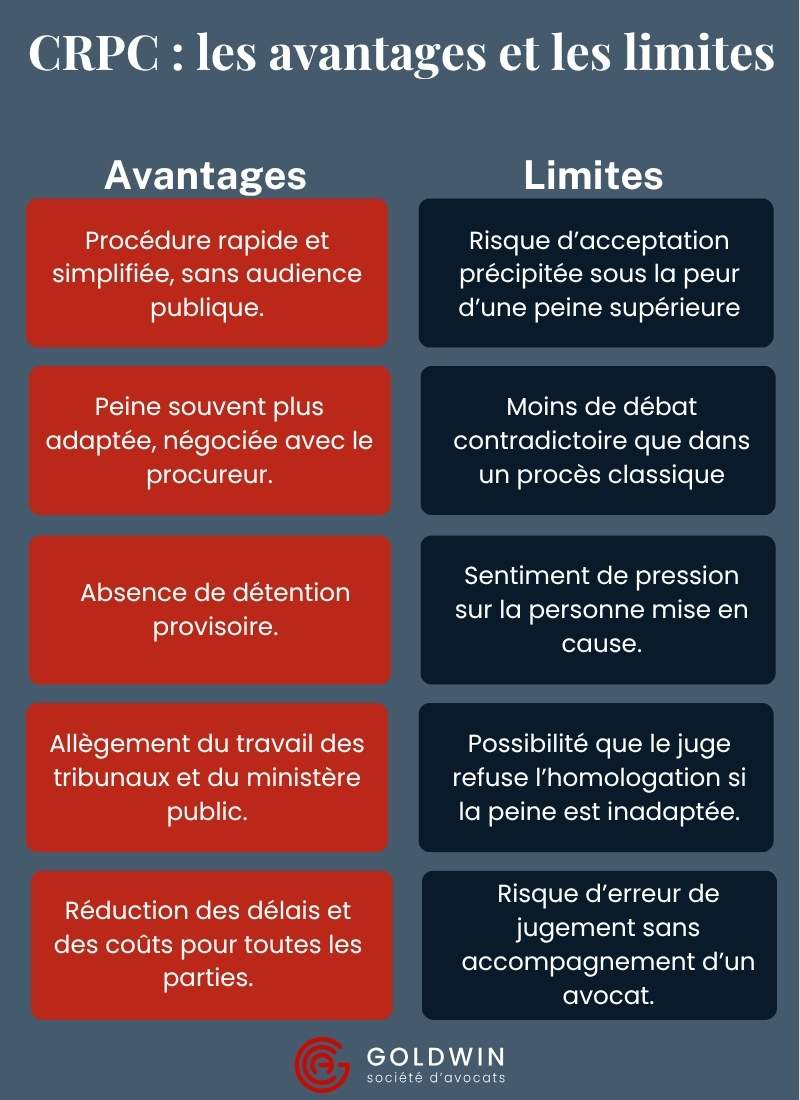
The CRPC offers tangible benefits for the accused and the public prosecutor. It allows an offence to be dealt with without pre-trial detention, avoids a public hearing and reduces the length of proceedings.
For the public prosecutor, it is an efficiency tool: the procedure lightens the burden on the judicial public service and speeds up the penal response. Penalties are often more appropriate and proportionate.
The CRPC should not be seen as an admission of weakness, but as a useful defence strategy in certain contexts.
The benefits of the CRPC for justice and the court
For the president of the judicial court, the CRPC helps to streamline the workings of the court. Judges can concentrate on complex cases, while simple cases are dealt with quickly.
This procedure illustrates the modernisation of the judicial framework, reconciling efficiency and respect for rights. However, the magistrate retains an essential supervisory role: he or she ensures that the sentence is in order and can refuse to approve it if it does not comply with legal requirements.
The CRPC is therefore a balanced alternative to the composition pénale, which is quicker but less protective of the accused.
The limits of prior acknowledgement of guilt
Critics point to the pressure felt by the accused. Fearing a higher sentence, some people accept the proposal without really thinking it through. This can undermine the principle of adversarial debate.
The judge must therefore ensure that the admission of guilt has not been obtained under duress. If there is any doubt, the case is referred back to the criminal court.
The assistance of a lawyer remains the best guarantee against any error of judgement or misinterpretation of the procedure.
Application of the CRPC in traffic law and traffic offences
The most common road traffic offences tried by CRPC
Traffic offences are at the heart of the CRPC procedure: driving without a driving licence, speeding, drink-driving or driving under the influence of drugs. These offences account for a large proportion of hearings. The public prosecutor favours the CRPC in these cases because it avoids pre-trial detention and speeds up the punishment. It is an appropriate response for clients who acknowledge the facts and wish to get back behind the wheel quickly within a clear legal framework.
Penalties incurred and proposed sanctions
Road traffic penalties are often accompanied by an additional measure: suspension of driving licence, fine or community service. The delegated judge ensures consistency between the seriousness of the offence and the penalty imposed. TheCRPC lawyer may ask for the sentence to be adjusted, for example for professional reasons. These interventions often make it possible to avoid disproportionate consequences for the client.
Alternatives to the CRPC procedure and possible appeals
Differences between CRPC, composition pénale and immediate appearance
Compositions pénales, CRPC comparisons sur reconnaissance and comparution immédiate share a common objective: to simplify the judicial response.
- The composition pénale procedure takes place without a public hearing.
- Immediate appearance is used in serious cases where there is a risk of pre-trial detention.
- The CRPC is based on the agreement of the accused and the public prosecutor, under the supervision of a magistrate.
Each mechanism has its advantages, but the CRPC remains the only procedure based on prior acknowledgement of guilt validated by a judge.
| Key elements | CRPC (Appearance on prior recognition of guilt) | Criminal composition | Immediate appearance |
|---|---|---|---|
| Principle | The accused acknowledges the facts and accepts a sentence proposed by the public prosecutor. | Alternative measure proposed by the prosecutor (fine, work placement, community service, etc.). | The accused is tried immediately after police custody. |
| Conditions of application | Recognised offences, penalty ≤ 5 years. | Offences or misdemeanours, recognised facts. | Flagrant offences, serious offences, suspect detained. |
| Presence of a lawyer | Mandatory. | Optional (often recommended). | Mandatory. |
| Procedure | Prosecutor’s proposal → defendant’s agreement → validation by a judge. | Prosecutor’s proposal → acceptance → approval. | Immediate public hearing before the criminal court. |
| Public | Public (homologation), with some exceptions. | Not public. | Public, with some exceptions. |
| Duration | Rapid (a few days to weeks). | Very fast (a few days). | Immediate, judgement immediately. |
| Sentence imposed | Sentence negotiated with the public prosecutor. | Alternative measure. | Sentence imposed by the court. |
| Effect for the accused | Avoids pre-trial detention + public hearing. | B1 registration only for 3 years. | Risk of immediate custodial sentence. |
| Main advantage | Speed + control over sentence. | Speed + no trial. | Immediate criminal response. |
| Main limitation | Requires full confession. | Measure perceived as symbolic. | Expeditious procedure, little time for defence. |
What happens if the defendant refuses the proposed sentence?
Refusing the proposed sentence is a fundamental right. In this case, the matter is referred back to the criminal court. The presiding judge will then hold a public hearing at which the defence can plead for acquittal or a reduced sentence. This referral should not be seen as a defeat. It is an opportunity to put forward substantive arguments or to challenge an inappropriate legal classification. The magistrate assigned to the case may then decide to partially annul the proceedings if an irregularity is detected.
CRPC with deferment: procedure and special features
The CRPC with deferment is often used as an alternative to an immediate appearance, which can reduce the risk of the accused being remanded in custody. However, this procedure does not guarantee that the accused will not be held in custody: the prosecutor or judge may still use it if the legal conditions are met and if the sentence incurred allows it. The CRPC on referral therefore facilitates a rapid indictment within a more controlled framework, without totally excluding the possibility of remand in custody.
The lawyer must check that the person concerned has fully understood the nature of the facts and is acting without pressure. The magistrate then checks the legality of the procedure and may refuse approval if the rights of the defence have not been respected.
After the decision: approval, enforcement and appeal
Challenging a sentence probate order
The decision may be challenged before the Court of Appeal within 10 days of notification. This appeal is made to a higher court, which re-examines the balance of the sentence and compliance with the legal framework. The role of the CRPC lawyer is crucial here: he or she checks that the procedure is in order and prepares the arguments needed for the defence.
The effects of a conviction on the criminal record
An approved conviction appears in the criminal record. However, acriminal lawyer may ask for the conviction not to appear on bulletin no. 2, in particular to protect the client’s career or reputation. This possibility, provided for by law, depends on the type of penalty and the seriousness of the offence. The judge will decide on a case-by-case basis.
Rehabilitation and deletion of the sentence after it has been served
After the sentence has been served in full, the criminal record can be erased by means of a pardon. The time limits for pardons are set out in article 133-13 of the Criminal Code. The benchmarks of 3, 5 or 10 years reflect the main categories of sentence, but they are not absolute thresholds: the exact length depends on the type of penalty and the absence of any new convictions.
TheCRPC lawyer assists the defendant in this process with the president of the court, in order to restore his or her legal and professional integrity.
Advice from a lawyer: accepting or refusing the proposed CRPC sentence
Before accepting a plea bargaining procedure, the accused must understand the real consequences of his choice.
The criminal lawyer analyses the strength of the evidence, the risk of a heavier sentence if the defendant refuses, and the most advantageous strategy depending on the profile of the case. His role is not limited to checking that the procedure is in order: he also assesses the court’s practice, the prosecutor’s expectations and the judge’s likely position at approval.
Pleading guilty is never a simple confession. It is a legal act that engages the client’s criminal and civil liability. The assistance of a lawyer is therefore essential to assess the effects of such a decision, negotiate a proportionate sentence and safeguard the rights of the defence.
Goldwin Avocats in Paris assists anyone considering a CRPC in order to secure the procedure, anticipate the sentence and defend their interests before the court appearance.
Conclusion: be well advised before a CRPC
Appearance on preliminary recognition of guilt is an effective but demanding procedure. It makes it possible to avoid a lengthy trial while accepting responsibility. However, every decision must be taken with discernment, because a mistake can leave a lasting mark. Acknowledging one’s fault does not mean relinquishing one’s rights. It means choosing to move forward within a controlled and humane legal framework.
Before any court appearance, contact Goldwin Avocats in Paris: our lawyers will help you plead guilty, negotiate the sentence and defend your interests before the judge.
Frequently asked questions about the CRPC