
- The issue: a creditor, holding a judgment that remained unpaid, sought the commencement of insolvency proceedings against a ready-to-wear clothing company.
- Decision: the court opened administration proceedings, following an investigation which confirmed that the company was no longer able to pay its debts.
- Outcome: An insolvency practitioner, appointed to represent the creditors, was appointed and a six-month observation period – a phase for assessing the company’s situation – was commenced.
Unpaid court order: the court declares the debtor to be in default
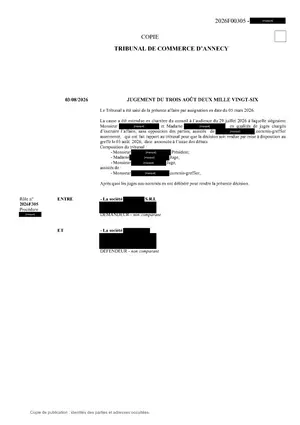
On 3 August 2026, the Annecy Commercial Court (Case No. 2026F00305) initiated administration proceedings against a debtor, at the request of a creditor represented by Goldwin Avocats. It found that the debtor had ceased payments: its available assets no longer covered its debts due. The decision illustrates how to bring proceedings against a debtor for administration, a procedure placing the company under court supervision, following an unpaid judgment.
An unpaid court order was the reason for the summons
The creditor brought the matter before the court because a judgment remained unpaid. On 20 May 2025, the Paris Commercial Court had ordered Company B to pay approximately €11,000 to the creditor. This enforceable judgement, authorising compulsory enforcement, had not been sufficient to secure payment.
Company A, represented by Goldwin Avocats, served its summons on 5 March 2026. The court first verified the debtor’s actual financial situation, a process which took five months:
| Date | Stage |
|---|---|
| 5 March 2026 | Summon served by the creditor |
| 9 April 2026 | Request for the proceedings to be reopened made by the debtor |
| 12 May 2026 | Investigation referred to a court judge |
| 9 July 2026 | Report in favour of administration |
| 3 August 2026 | Commencement of administration proceedings |
Insolvency established by the court’s investigation
Insolvency proceedings have been opened: bringing proceedings against a debtor in insolvency is successful if their insolvency is proven. The court followed the report of the investigating judge, tasked with examining the company, and the favourable opinion of the public prosecutor.
Insolvency was established within the meaning of Article L. 631-1 of the Commercial Code: the available assets no longer covered the current liabilities. They did not exceed €20,000, whilst trade payables were significantly higher and there was a debt owed to URSSAF. Insolvency is demonstrated by figures, not by isolated outstanding payments.
The court set the date of insolvency as 6 February 2026, the date of a URSSAF recovery order. There was no evidence to suggest that a recovery was manifestly impossible, which is a condition for immediate liquidation (Article L. 640-1). This date marks the start of the ‘suspicion period’, during which certain payments may be set aside.
What the decision changes for an unpaid creditor and for a director
For the creditor, payment is now subject to the collective proceedings. Article L. 622-21 of the Commercial Code prohibits any further attachment following the order commencing proceedings. Recovery is achieved through the filing of a claim, not through attachment.
The procedures follow a specific order:
- Check the notice of the order commencing insolvency proceedings published in the BODACC.
- File your claim with the insolvency practitioner within the statutory time limit.
- Enclose the enforceable title, invoices and a statement of interest.
For company directors, Article L. 631-4 of the Commercial Code requires them to apply for the opening of proceedings within 45 days of the cessation of payments. Any delay may render the director liable.
Do you have a court judgement or unpaid invoices? Each case is assessed on a case-by-case basis: contact our company law solicitors in Paris to discuss a summons.
Related areas of expertise
Commercial law › Solicitor for companies in financial difficulty
Frequently asked questions about being placed in administration
Yes. Article L. 631-5 of the Commercial Code allows a creditor to take legal action against their debtor, regardless of the nature of the debt. However, they must prove that the debtor has ceased payments. The court may order an investigation before giving its ruling, as in this case. A single outstanding payment is not always sufficient: the judge examines the company’s overall situation.
It must be lodged with the insolvency practitioner. The time limit is two months from the publication of the order commencing proceedings in the BODACC (Article R. 622-24 of the Commercial Code). This is extended to four months for creditors based outside mainland France. Once this deadline has passed, the claim is excluded from the distribution of assets, unless a waiver of the time limit is granted, i.e. authorisation to lodge the claim after the deadline granted by the insolvency judge.
Six months initially, as in this case. Article L. 621-3 of the Commercial Code allows for a renewal, followed by an exceptional extension, up to a total of eighteen months. No later than two months after the commencement of proceedings, the court shall verify that the company is able to finance the continuation of its business (Article L. 631-15).


Jonathan BELLAICHE