
Key points
- Issue: A manager, who is a partner via his holding company, refuses to sign the deed of sale for his shares following the exercise of a call option.
- Decision: the judge hearing the interim application ordered the transfer, as the obligation was not seriously disputable following the manager’s written acceptance.
- Outcome: the agreement must be signed within eight days upon payment of the purchase price, with a penalty of €1,000 per day, the return of a mobile phone and €3,000 in costs.
Outgoing manager refuses to sign: sale of his shares ordered, subject to a penalty payment
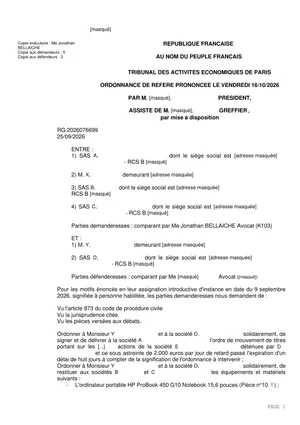
The President of the Paris Commercial Court, in summary proceedings on 16 October 2026 (Case No. 2026076699), ordered the compulsory sale of a departing manager’s shares to the majority shareholders, represented by Goldwin Avocats. The manager had initially agreed to the sale but subsequently refused to sign. The decision illustrates how a partner can be compelled to sell their shares swiftly.
A managing partner who refuses to sign over his shares
The dispute pits the majority shareholders against a manager who refused to sell his shares to them following his departure. Having acquired a stake in the company in April 2024, he transferred them in March 2025 to his holding company, a firm which holds his shareholdings and of which he is chairman.
The shareholders’ agreement of 27 October 2025 provided for a purchase option in the event of the manager’s departure. This clause allowed the majority shareholders to repurchase all his shares, held directly or via his holding company, at the subscription price: €1 per share.
On 16 July 2026, the majority shareholders exercised the option on the day the holding company’s service contract was terminated. The manager accepted the sale in writing whilst demanding repayment of his shareholder’s current account (sums lent to the company). He never signed the deed and continued to use a company mobile phone.
Compelling a shareholder to sell their shares by way of interim relief: the judge’s reasoning
The judge agreed to compel a shareholder to sell his shares, as the obligation was not seriously disputable. Article 873(2) of the Code of Civil Procedure therefore allows the judge hearing the summary proceedings, acting in an emergency, to order specific performance. Under Article 1124 of the Civil Code, the exercise of the option constitutes a sale.
As chairman of the holding company, a simplified joint-stock company, the manager was bound by this provision (Article L. 227-6 of the Commercial Code). The judge dismissed every argument put forward by the defence:
| Argument by the defence | The judge’s response |
|---|---|
| Lack of standing to bring proceedings | Standing assessed without ruling on the merits (Articles 31 and 122 of the Code of Civil Procedure) |
| Holding company not a signatory to the agreement | Its chairman accepted the transfer on its behalf |
| Clause void on the grounds of a derisory price | Action on the merits has no effect given the written acceptance |
What the ruling means for shareholders dealing with an outgoing manager
Written acceptance binds the transferor: the judge hearing the interim application may then order the transfer within a few weeks, without waiting for the judgment on the merits. Conditions added retrospectively, such as the payment of fees, do not prevent the sale.
To enforce a call option, the majority shareholders would be well advised to ensure they have:
- the signed agreement, which also covers the shares in the holding company;
- the dated notice of the exercise of the option;
- the seller’s written acceptance of the sale;
- the deed of sale addressed to the holding company’s representative.
The agreement expressly covered the manager’s holding company, a point that should have been provided for when the shareholders’ agreement was drawn up.
Each situation must be analysed on a case-by-case basis.
Is a shareholder refusing to comply with a clause requiring the repurchase of their shares? Contact one of our solicitors specialising in disputes between shareholders to review your agreement.
Related areas of expertise
Company law › Solicitor specialising in disputes between shareholders
Frequently asked questions on the compulsory transfer of shares between shareholders
Yes, where the obligation to transfer is not seriously disputable. Article 873(2) of the Code of Civil Procedure allows for an order to be made requiring a specific act, such as signing the securities transfer order, the document that transfers the shares. In this case, the judge set a deadline of eight days, followed by a penalty payment of €1,000 per day of delay for a period of sixty days.
No, not in this case. The defendants considered the price of €1 per share to be derisory, as the shares had been valued at around €9 when the agreement was signed. The judge held that their written acceptance of the sale meant the obligation could not be seriously contested, despite the proceedings on the merits. Without such a written document, the analysis might have been different.
No, according to this order. The judge ruled that these conditionswere unrelated to the shareholders’ agreement: the repayment of the current account and the fees were covered by other agreements. They did not call into question the principle of the transfer. The transferor may still claim these sums through the appropriate channels, in separate proceedings.


Jonathan BELLAICHE