





Summary
- Understanding police custody: definition, duration and legal framework
- The role of the criminal lawyer during police custody
- What happens after police custody?
- Choosing a criminal lawyer for police custody
- What should you do in the first few minutes? React quickly, avoid mistakes
- Conclusion: defending yourself from the outset means protecting yourself for the long term
What did you think of this article? Rate it!
TEAMS
Our lawyers
Skill
Our expertise in Commercial Law
Criminal lawyer for police custody: your rights and defence strategy from the outset
All you need to know about embezzlement with your criminal lawyer
Personal data theft: contact your lawyer!
The role of your lawyer in managing your commercial disputes
Managing conflicts between heirs with your lawyer
Your customs lawyer in Paris
Tax inspections: your public law lawyer will defend you!
European arrest warrant: an update from your criminal lawyer
Your extradition lawyer – Goldwin Avocats in Paris
A retenir
- Police custody is a coercive measure, not a punishment. It may only be used against a person suspected of an offence punishable by imprisonment, and must be strictly regulated by law.
- Persons in police custody have essential rights: the assistance of a lawyer from the first hour, the right to remain silent, to be examined by a doctor, to notify a relative and to access certain documents in the case file.
- Thecriminal lawyer checks that the detention is in order, attends the hearings, verifies the minutes and ensures that the procedure is followed at every stage.
- At the end of the measure, the person may be released, summoned or brought before a magistrate, depending on the seriousness of the facts.
- Goldwin Avocats intervenes immediately in Paris and the Paris region to ensure that rights are respected and to build an effective defence from the outset.

Understanding police custody: definition, duration and legal framework
What is police custody?
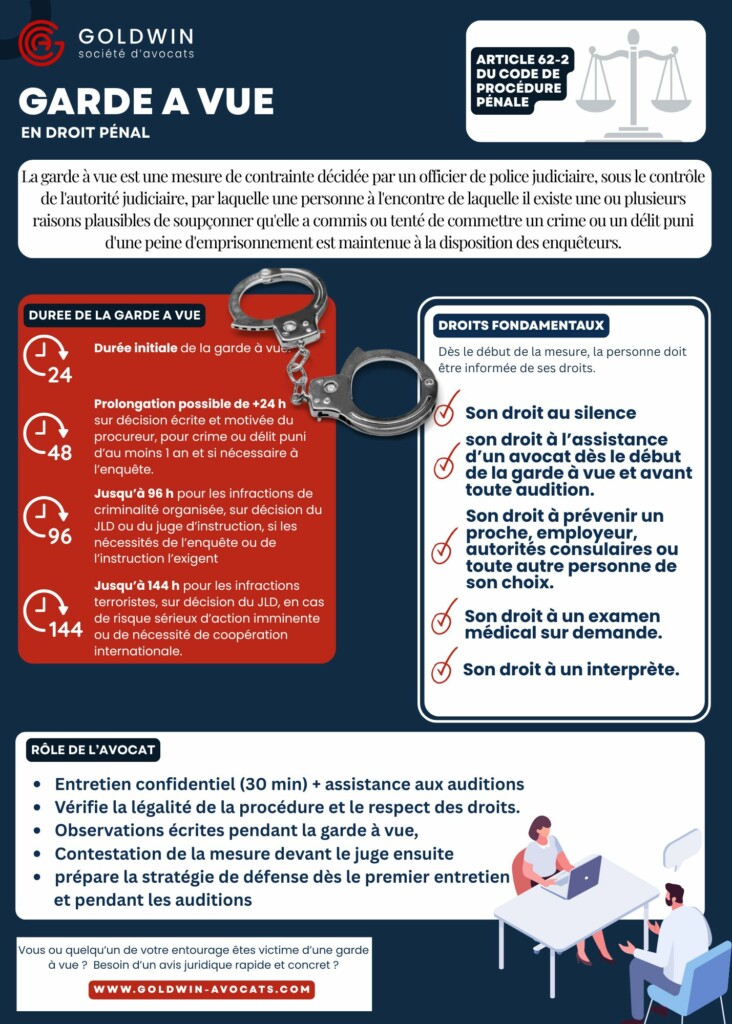
Police custody is a coercive measure decided by a judicial police officer (OPJ), under the supervision of the public prosecutor. It is used to detain a person suspected of having committed or attempted to commit an offence punishable by imprisonment, so that the investigation can continue andthe necessary interviews can be held. Provided for in article 62-2 of the Code of Criminal Procedure, the purpose of this measure is to verify the charges and determine the exact role of the person in police custody in the investigation. It is not a penalty, but a stage in the judicial process. It is a tense moment, often experienced as a brutal denial of freedom.
The role of the criminal lawyer is to supervise this period so that the procedure respects the rights and dignity of the individual.
What happens in police custody?
Police custody generally begins with a stop on the public highway, an identity check or a summons to the police station. From that moment on, the person is deprived of their liberty and taken to a police custody cell, under the control of a judicial police officer acting under the supervision of the public prosecutor.
On arrival, the detainee is informed of the nature of the charges against them and of their fundamental rights, in a language they understand. The OPJ also specifies thealleged offence and the circumstances of the arrest.
The measure is carried out within a strict framework: handcuffing is only authorised in the event of danger or risk of escape. The detainee must be allowed to eat and drink and must ask to be examined by a doctor appointed by the public prosecutor or the investigating officer; a further examination may be ordered if the detainee’s state of health warrants it.
The detainee may notify a relative within three hours of placement.
The assistance of a lawyer is an essential right: chosen by the detainee or appointed by the court, the lawyer must be notified immediately. After a confidential interview, the lawyer may consult the main procedural documents accessible during police custody (arrest report, notification of rights, medical certificates, minutes of the hearing and confrontation with the detainee) and attend hearings to ensure that rights are respected.
During the hearings, the detainee may respond or remain silent, the latter being an absolute right.
Searches continue to be regulated: the police may carry out a security palpation, use electronic detection equipment and, if this is not sufficient and the needs of the investigation so require, carry out a full search in a closed area by a person of the same sex.
A report is drawn up for each interview, which the interviewee may refuse to sign if the content does not correspond to his or her statements.
The public prosecutor monitors the legality of the measure throughout.
Thecriminal lawyer monitors each stage to ensure that the law is complied with and that the defence is protected.
Conditions of police custody
Police custody may only be ordered if there are one or more plausible grounds for suspecting that a person has committed or attempted to commit a crime or an offence punishable by imprisonment.
In other words, for purely minor offences, such as minor speeding or parking fines, police custody is illegal: the person can be heard freely, but cannot be deprived of their liberty. The decision to place the person in police custody is taken by a judicial police officer, under the supervision of the public prosecutor, who must check that the measure is necessary (to preserve evidence, prevent suspects from colluding, ensure that the person is brought before the courts, etc.).
Duration of police custody
The duration of police custody begins at the precise moment of deprivation of liberty, i.e. when the person is no longer able to leave the premises freely, even if they have not yet been taken to the police station or heard. This clarification is essential: the minute of arrest marks the starting point for calculating the legal 24 hours. It is recorded in the official report.
The initial period is 24 hours, which can be extended once by the public prosecutor to a maximum of 48 hours.
Certain serious offences, such as drug trafficking or organised crime, allow for an exceptional extension of up to 96 hours, or even 144 hours (i.e. 6 days) for a terrorism-related offence.
In all cases, each extension must be justified, notified to the person in police custody and approved by the judicial authority.
It is often at this stage that an experienced criminal lawyer, present from the very first hour, can verify the legality of the detention and alert the public prosecutor to any irregularities or miscalculated duration.
Fundamental rights of persons in police custody
Respecting the rights of persons in police custody is a legal obligation under the Code of Criminal Procedure. As soon as a person is placed in police custody, the judicial police officer must inform them of all their essential rights. These rights are guaranteed regardless of the place of detention (police station, gendarmerie or specialised investigation department).
- Notification of placement and maximum duration
The detainee must be informed immediately that he or she has been placed in police custody, of the maximum duration of the measure (24 hours, renewable once), and of the precise reason for the detention. This notification must mention the date, time and nature of the alleged offence. - Right to legal assistance from the first hour
Since the Act of 14 April 2011 on police custody, detainees have been able to choose a lawyer, or request a court-appointed lawyer if necessary, from the outset. The lawyer is authorised to consult the police custody record, to confer confidentially with his client every 24 hours (i.e. every extension) in a room set aside for this purpose, and to attend interviews. This right may only be deferred in the event of anabsolute emergency or anoffence involving organised crime, and always under the supervision of the public prosecutor. - Right to a medical examination
Anyone held in police custody may ask to be examined by a doctor (who cannot be chosen by the detainee) to check their state of health, report any injuries or attest to their physical condition. This right is essential in cases of pathology, ongoing treatment or suspected violence. - Right to notify a relative or employer
Anyone held in custody may notify a person of their choice (relative, friend, spouse) as well as their employer. If the person is a foreign national, they may ask that their consulate be informed. These contacts help to avoid isolation and to prepare for the appointment of a lawyer more quickly. - The right to the assistance of an interpreter
If the detainee does not understand French, he or she has the right to be assisted by an interpreter for all communications: notification of rights, hearings, signing of minutes. The absence of an interpreter renders the procedure irregular. - Right to remain silent
The right not to answer questions is a pillar of the right of defence. Silence can never be interpreted as a confession. It is a right not to incriminate oneself .
The lawyer explains to the person in custody when it is preferable to answer, and to what extent silence can protect his or her defence. - Right to submit written observations
The person in custody may, at any time, submit written observations to the magistrate in charge of the procedure, in particular to point out an irregularity or inappropriate treatment. - Right of access to certain documents in the case file
The lawyer has access to essential documents: the placement report, notification of rights, medical certificates and hearings already held. This access enables the regularity of the procedure to be checked and the defence strategy to be adapted.
These rights must be reiterated at every stage, particularly in the event of an extension or change of classification of the offence.
Thecriminal lawyer checks that all these formalities have been complied with. If he forgets to do so, if there is no interpreter or if the hearing was held without a lawyer, he can argue that the record is null and void before the court.
If you are held in police custody, contact Goldwin Avocats in Paris immediately: an experienced criminal lawyer can intervene from the outset to ensure that your rights are respected.
The role of the criminal lawyer during police custody
When a person is held in police custody, time becomes their adversary. Every minute without a lawyer can have serious consequences. The criminal lawyer is not there simply to reassure: he acts, anticipates and protects.
The lawyer’s involvement from the very first hour
The initial confidential interview is a crucial moment. It lasts a maximum of 30 minutes and enables the detainee to understand the situation, his or her rights and the risks involved. The lawyer listens, asks questions and then establishes an initial defence strategy. He helps his client to formulate answers clearly and carefully during the first hearing. They also check the conditions of the detention: notification of rights, state of health, length of custody and compliance of the minutes.
This interview is often the only time for discussion without the police being present. It allows the detainee to ask any questions they may have and to catch their breath after the shock of the arrest.
The lawyer is bound by professional secrecy: he or she may not disclose any information to the family or to third parties throughout the period of police custody.
His role is limited to advising and defending his client within the strict framework of the procedure, without passing on the slightest element relating to the investigation or the statements made during custody.
A lawyer available 24 hours a day for urgent criminal matters, such as those at Goldwin Avocats in the 16th arrondissement, can act in Paris and the Ile-de-France region. Their immediate presence changes the outcome of the case: a well-prepared hearing can avoid involuntary confessions or contradictions in the minutes.
Assistance during hearings and confrontations
Police custody is a tense dialogue between investigators and suspects, where every word counts. The criminal lawyer attends every hearing and confrontation. He ensures that the questions asked are regular, that the tone used is appropriate and that there is no psychological pressure. They can intervene at any time to remind the client of the right to remain silent or to ask for a question to be rephrased.
His role is also to prepare his client between hearings: explaining what has been said, helping him to remain calm and not become confused by fatigue.
This constant presence ensures a solid defence from the outset of the legal process. An experienced lawyer also knows how to spot flaws in a case, inconsistencies in observations or procedural flaws.
In this way, as early as the police custody stage, they prepare the strategy that will later be used in criminal court.
If you or someone close to you is summoned or taken into police custody, contact Goldwin Avocats immediately. A criminal lawyer in Paris will assist you during hearings and confrontations, guaranteeing the fullest possible defence.
The limits of the lawyer’s action
A criminal lawyer cannot do everything during police custody. The law sets precise limits on their involvement. They do not have access to the entireinvestigation file, but only to certain essential minutes. Nor may he be present during certain technical procedures such as searches or immediate forensic examinations.
However, he may submit written observations to the file and alert the public prosecutor if fundamental rights are infringed.
The lawyer is not simply an observer: he acts, even from a distance. The most important thing is to be vigilant: to check every signature, every time and every entry in the record. It is often these details that determine the validity of a procedure.
If you need assistance in police custody, Goldwin Avocats can provide you with a criminal lawyer in Paris and the Ile-de-France who can intervene rapidly at police stations, gendarmeries and magistrates’ courts.
What happens after police custody?
The end of police custody does not mean the end of the case. The case file is forwarded to the public prosecutor, who decides what legal action will be taken. Depending on the evidence gathered, the person may be released, summoned or referred to a court. At this stage, the involvement of a criminal lawyer is crucial in preparing the defence and protecting the detainee‘s fundamental rights.
Possible outcomes of police custody
The detainee is released
If the person is released, there are several possible outcomes:
- Dismissal
The public prosecutor decides to close the case when the facts do not constitute an offence, the evidence is insufficient or there is no legal interest in prosecuting. The lawyer checks the notification, ensures that the procedure is in order and that the file does not contain any unfavourable remarks. - Summons to appear by a judicial police officer (COPJ)
The person is summoned to appear before the criminal court at a later date, particularly if the offence was committed on French territory. This period allows the lawyer at the bar to prepare the defence and request access to the case file in order to organise the strategy. - Alternative procedures
The public prosecutor may propose a penal composition, mediation, or an appearance based on prior acknowledgement of guilt (CRPC).
This decisive outcome often results in a lighter sentence. The criminal law master ensures that the person accepts the proposal with full knowledge of the facts.
The person is referred to court
This means that the person is not released at the end of police custody but is brought before a magistrate because of the seriousness of the acts or the need for further investigation. When the facts are serious, the person may be brought before a magistrate on the same day, in accordance with article 803-2 of the Code of Criminal Procedure.
- Either before the public prosecutor
The public prosecutor may decide to close the case, propose a CRPC, initiate an immediate appearance for offences punishable by at least 2 years’ imprisonment, or schedule a hearing before the criminal court within a period generally ranging from 2 to 6 weeks. In the case of an immediate appearance, the accused, assisted by his criminal lawyer, has the right to request a postponement in order to prepare his defence effectively.
- Or before the investigating judge
If an in-depth investigation is required, the public prosecutor opens a judicial inquiry. The judge then conducts a preliminary examination (IPC), which may result in an indictment or assisted witness status.
The judge may then order that the person be placed under judicial supervision, placed under house arrest or remanded in custody.
These decisions are supervised by the liberty and custody judge (JLD).
The role of the lawyer after police custody
Check the procedure and ensure follow-up
After police custody, the criminal lawyer in charge of police custody ensures a complete follow-up: verification of the minutes, notification of rights and compliance with the rules of the Code of Criminal Procedure. Any irregularity may result in the procedure being declared null and void.
Goldwin Avocats has solid expertise in criminal matters and also offers online consultations for any requests for immediatelegal assistance.
Preparing to appear or negotiate
If a summons to appear or an immediate court appearance is scheduled, the lawyer will explain how police custody works, the next steps, the costs and fees, and the risks involved.
He can also negotiate a CRPC to obtain a quicker and more balanced solution, particularly in cases involving road traffic offences, consumer law orminor offences.
The human and strategic role of the criminal lawyer
The criminal lawyer remains a point of reference for the client and his family. He represents victims or alleged perpetrators in law, explains decisions and ensures that the right to assistance is respected. They may also act in related areas: civil law, employment law, personal injury law and victim compensation, or immigration law.
Goldwin Avocats, which operates in criminal law and other areas of law, is available online for any legal consultation.
For a criminal emergency in Paris or elsewhere in France, you can contact Goldwin Avocats.
Specific cases: minors, foreign nationals or repeat offenders
Not all police custody is the same. Some situations require greater protection.
Police custody of minors
For minors, the law distinguishes between several cases:
- Under 13: no police custody possible, only a 12-hour detention (renewable once) decided by a judicial police officer with the prior agreement and under the supervision of the public prosecutor or investigating judge, for an offence punishable by at least five years’ imprisonment.
- Aged 13 to 15: police custody possible for offences punishable by at least 5 years’ imprisonment, with extension only with the authorisation of the magistrate.
- From the age of 16: similar regime to that for adults, but with additional safeguards (information of legal representatives, greater involvement of the lawyer and application of the specific rules of the Code of Criminal Justice for Minors).
In all cases, a lawyer must be present andthe legal representative must be informed immediately.
Police custody of foreign nationals
Foreign nationals face other obstacles: language barrier, absence of close family, precarious administrative status. In these cases, the lawyer will ask for an accredited interpreter, contact the consulate and check that the procedure complies with France’s international commitments.
Police custody for repeat offenders
In the case of repeat offenders or people already known to the police, the risk of prolongation or pre-trial detention is higher. The lawyer prepares the defence carefully, anticipating the prosecution’s arguments.
Choosing a criminal lawyer for police custody
When should you contact a lawyer in police custody?
The right time is right away. As soon as you are summoned orarrested, it is crucial to contact a lawyer. If the person is unable to do so themselves, a close friend or family member can telephone a criminal law firm in Paris to request immediate intervention. Police stations and gendarmeries have a list of duty lawyers, but it is always preferable to call your own counsel.
The speed of contact makes all the difference: a lawyer who intervenes within the first hour can attend the confidential interview, check the procedure and avoid mistakes that will later weigh heavily on the trial.
WHAT YOU NEED TO KNOW: List of information you need to give your lawyer so that he can intervene quickly:
- Full identity: surname, first name, date of birth, nationality.
- Place of custody: police station or gendarmerie + telephone number.
- Time of placement: estimated start of the measure.
- Reason for police custody: offence cited (theft, violence, drugs, etc.).
- State of health: injuries, treatment, frailty, etc.
- Name of the lawyer chosen or “court-appointed”.
- Details of close contact: name and number.
Criteria for choosing a criminal lawyer
There’s more to a good criminal lawyer than his degree. What counts is their responsiveness, availability and experience in criminal emergencies.
There are several criteria to consider when choosing a lawyer:
- whether he specialises in general criminal law or business law ;
- ability to intervene at any time in the Paris area;
- experience before the criminal court or the examining magistrate’s court;
- clarity in the presentation of fees.
Fees vary according to the length of police custody, the complexity of the case and the amount of travel required.
Contact a criminal lawyer in Paris for immediate assistance: the Goldwin Avocats team is available 24 hours a day to intervene at police stations and gendarmeries in the Paris region.
What should you do in the first few minutes? React quickly, avoid mistakes
Fear, incomprehension and haste are the worst enemies of anyone taken into police custody. But a few simple steps can change everything.
- Stay calm. Speak little, listen a lot. Every sentence will be recorded in the minutes.
- Ask for a lawyer. This is your fundamental right. No hearing should begin without one.
- Refuse to be pressured. You have the right to remain silent, even if you are pressured to speak.
- Tell someone close to you. They can alert a lawyer, particularly if you are being held in another town.
- Don’t sign anything you don’t understand. You can refuse to sign a statement if you disagree with it.
These simple reflexes help to limit irreversible errors. If you are held in police custody in Paris or the suburbs, a criminal lawyer from Goldwin Avocats can intervene quickly to assist you and prepare your defence from the outset.
Conclusion: defending yourself from the outset means protecting yourself for the long term
Police custody is a decisive stage where every minute counts. Every hearing, every report, every decision by the prosecutor can influence the outcome of the proceedings. The assistance of a criminal lawyer guarantees that your rights will be respected, that you will be in control of the exchanges and that you will be able to prepare an effective defence from the outset.
Goldwin Avocats, based in Paris, provides urgent legal assistance throughout the Île-de-France region to ensure rigorous and strategic legal protection. Contact Goldwin Avocats criminal lawyers without delay: in criminal matters, responsiveness is your best defence.