






A retenir
- Identify the false accusation: it may be a slanderous accusation, defamation orinsult, depending on the nature of the comments and who made them.
- React without haste: preserve evidence, avoid any public response and contact a criminal lawyer as soon as you are summoned.
- Choose the right recourse: complaint, mediation or civil action, depending on the seriousness and proof of bad faith.
- Preserve your reputation: do not publish anything on social networks, remain factual and seek reliable legal advice.
- Rebuild: seek judicial and digital rehabilitation with the help of a specialist firm such as Goldwin Avocats.
A false accusation needs no proof to shatter a life. All it takes is unfounded testimony, a post on social networks, or a false complaint lodged at the police station for everything to fall apart. Your reputation crumbles, your job falters, and thehonour you’ve spent years building is thrown away.
But the law provides a framework for these abuses: slanderous denunciation is defined by the Criminal Code (article 226-10), while defamation is covered by the law of 29 July 1881 on freedom of the press (article 29). Behind these legal terms lies the same reality: the suffering of someone wrongly accused, whether they are an employee, a company director, a teacher or a parent. In the face of such an attack on freedom and dignity, there are remedies available.
A lawyer specialising in criminal law can help you to lodge a complaint, establish proof of the lie, and present a solid case in court. This step-by-step guide explains how to react, protect your innocence and regain control of an unjustified situation.
Understanding the nature of a false accusation
What is a false accusation?
A false accusation is an allegation made against a person when the facts are false or partially inaccurate. In law, it becomes an offence when it is made to a public authority with the clear intention of causing harm.
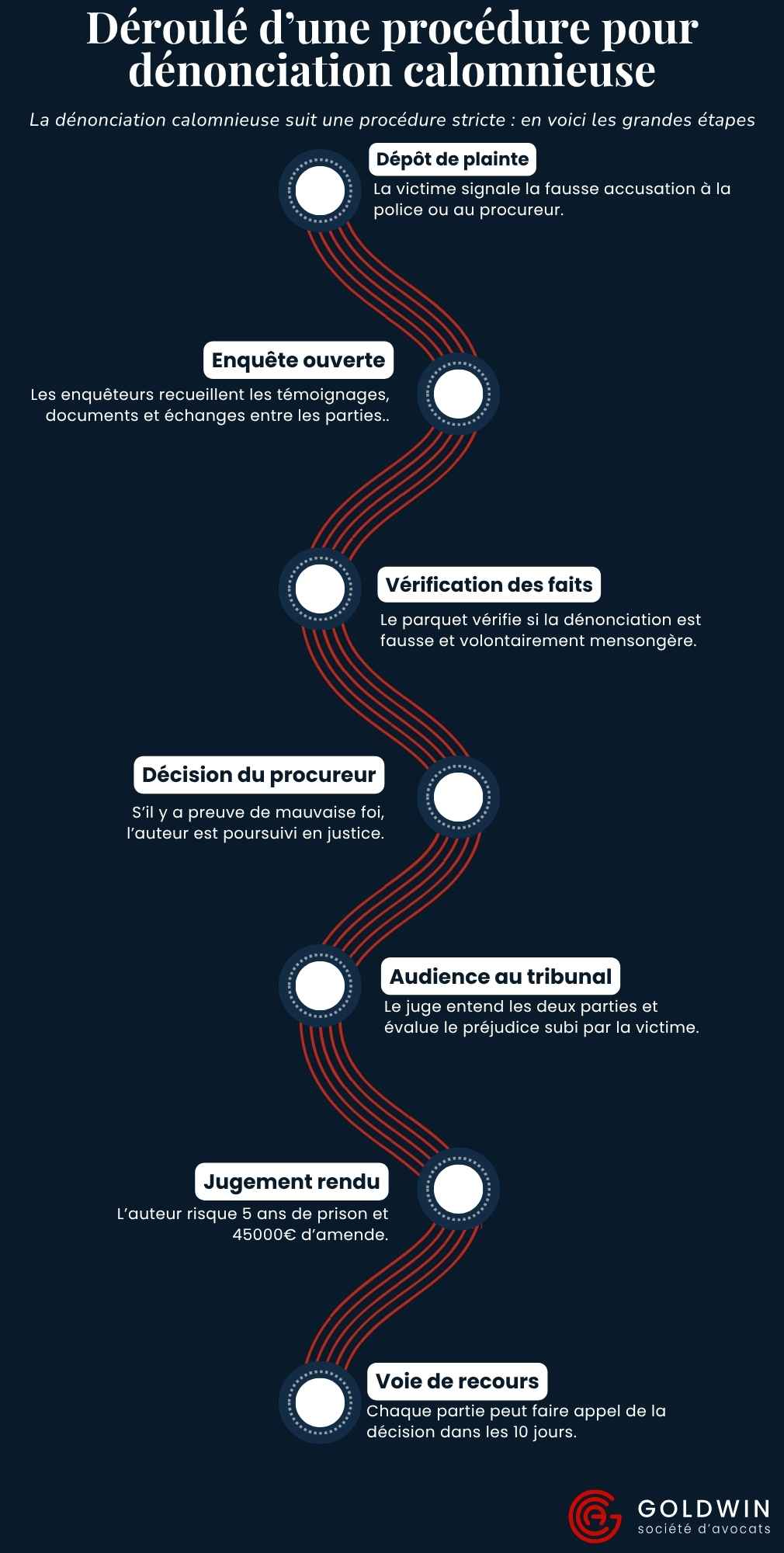
The Penal Code punishes this behaviour under the term of slanderous denunciation. This criminal offence targets anyone who falsely accuses someone, knowing that the facts reported are false. The penalty can be up to 5 years’ imprisonment and a €45,000 fine.
In moral terms, false accusation is a formidable weapon: it destroys the confidence, reputation and sometimes the entire life of the person accused. It installs doubt in society and undermines justice, because it distracts the law from its primary objective: the truth.
The difference between false accusation, defamation, insult and slander:
- Defamation is an unfounded public accusation that impugns a person’s honour.
Example: An Internet user posts on Facebook: “The school headmaster embezzles money from the canteens”.
This public accusation is specific(embezzlement) and unproven. It damages the headmaster’s reputation: this is defamation.
- Insult consists of offensive comments without imputation of a specific fact.
Example: During a debate, someone writes: “You’re nothing but an incompetent and a parasite!
No specific facts are imputed, just insulting words. This is an insult.
- Slanderous denunciation concerns false complaints or reports made to an authority.
Example: An employee sends a complaint to the police claiming that his colleague is stealing equipment, when he knows perfectly well that this is not true.
This is a false report made to an authority, and therefore constitutes slanderous denunciation.
The most common forms of false accusation
In the private sphere (family, couple, neighbours)
False accusations often arise in a highly emotional context: break-up, custody of children, neighbourhood problems. A parent may be wrongly accused of ill-treatment, an ex-spouse of harassment or violence. In these cases, the complaint is lodged with an authority – police station, gendarmerie, public prosecutor – on the basis of unfounded statements.
These false and slanderous accusations can have serious consequences: suspension of visiting rights, loss of accommodation, family breakdown. They require a swift and legally regulated response.
At work (superiors, colleagues, harassment, professional misconduct)
In the workplace, a false accusation may take the form of a report of harassment, theft or serious misconduct. A colleague or employer may initiate an unjustified internal or disciplinary investigation.
The wrongly accused employee risks dismissal or dismissal for misconduct, with significant administrative and financial consequences.
The advice of a lawyer specialising in employment law and criminal law is therefore essential in putting together a defence before the industrial tribunal and the criminal court.
On the Internet (online defamation, social networks)
A defamatory post on Facebook, Instagram or X (formerly Twitter) can destroy a reputation in a matter of hours. These defamatory or insulting comments constitute a press offence, governed by the law of 29 July 1881. They may justify a complaint for public defamation, or non-public defamation if the comments are circulating in a closed group.
The speed of dissemination on social networks makes reaction crucial: evidence must be preserved before any content is deleted, and a specialist lawyer must then be alerted. A person who has been the victim of a false accusation online can then ask for the content to be deleted, or even for damages.
Possible consequences for the accused person
The repercussions of a false accusation are manifold.
- Criminal consequences : the accused person may be summoned by the police, placed in police custody or placed under investigation. Even if they are innocent, this procedure creates a record in the judicial registers.
- Personal and professional consequences: beyond the emotional shock, professional and social reputations are permanently damaged. In a context where employers and colleagues react quickly, the mere existence of a complaint can lead to the loss of a job or a hierarchical conflict.
- Administrative consequences: certain professions (teachers, civil servants, lawyers, doctors) are automatically suspended if a complaint is lodged.
- Do not respond publicly to accusations.
- Do not threaten the perpetrator: this could backfire.
- Do not publish your version on social networks.
- Contact a lawyer first, then gather the evidence.
Identify the legal levers to prove your good faith
The conditions for making a false accusation
For a false accusation to become an offence of slanderous denunciation, four conditions must be met:
- The accusation is based on false or unfounded facts.
- The perpetrator knew they were false at the time of the complaint.
- The accusation has been made to a competent authority (police, gendarmerie, public prosecutor, administration).
- Bad faith is demonstrated by concrete evidence: contradictions, lies, manipulation.
This combination proves intent to harm, an essential element of the offence. Demonstrating bad faith is often the most complex part. Only an experienced criminal lawyer will be able to help you establish it through legal argument and rigorous evidence gathering.
Outline of the procedure for making a slanderous accusation:
Evidence to be gathered in order to defend yourself
The key to an effective defence lies in the quality and diversity of the evidence gathered.
- Written documents: e-mails, text messages, letters, statements. These can be used to establish the chronology of events and prove the perpetrator’s inconsistencies.
- Testimonials : colleagues, neighbours, friends or relatives can provide sworn statements.
- Bailiff’s reports: these freeze digital elements before they are deleted.
- Digital evidence: messages on social networks, connection logs, metadata, time-stamped screenshots.
10 pieces of evidence to collect before filing a complaint :

A Goldwin Avocats criminal lawyer can help you with this essential step, to ensure that your case is admissible and has legal force.
Possible remedies
File a complaint for slanderous denunciation
When someone is wrongly accused, the first step is often to lodge a complaint for slanderous denunciation. This can be done with the police, the gendarmerie or directly with the public prosecutor.
The limitation period is three years from the date on which the falsity of the facts was recognised by a court decision or objective evidence. Once this period has elapsed, the complaint is no longer admissible.
The main pitfall of this procedure is that the case is often dismissed when the perpetrator’s bad faith is not clearly established. It is not enough to show that the accusation is false: it must also be proven that it was made knowingly to cause harm.
However, victims can get round this inertia on the part of the public prosecutor. By registering as a civil party, they can refer the case directly to an examining magistrate, which requires an investigation to be opened. This is a longer and more costly option, but it does allow progress to be made in a case that is often left unresolved.
Filing a complaint for public or private defamation
But not all false accusations are made to the authorities. Some are circulated publicly, in the press or on social networks, and in these cases fall under the heading of defamation.
When a defamatory statement is disseminated to a wide audience, you need to act quickly: the statute of limitations is only three months. After that, no action can be taken.
The first step is to keep the evidence (screenshots, links, date of publication), then contact a press law lawyer to lodge the complaint before the time limit expires.
This type of recourse is particularly effective when the false accusation has damaged a person’s reputation or honour on the Internet or in the media.
Other avenues: mediation, right of reply, civil party complaint, etc.
Certain situations make it possible to avoid criminal proceedings: mediation, right of reply in the press, or civil action for damages.
The law offers a range of responses, from the most peaceful to the most firm, depending on the seriousness of the facts.
Limitation periods for the main offences :
| Offence | Limitation period | Legal reference | Starting point of the period |
|---|---|---|---|
| Slanderous denunciation | 6 years (Except under special regimes) | Article 8 of the Code of Criminal Procedure | From the day on which the offence was committed. |
| Public defamation | 3 months, except in discriminatory form (1 year) | Article 65 of the law of 29 July 1881 | From the date of publication (press, website, social network, etc.) |
| Non-public defamation (e.g. between private individuals) | 3 months, except in discriminatory form (1 year) | Article 65 of the law of 29 July 1881 | From the day on which the comments were made or broadcast. |
| Public insult | 3 months, except in discriminatory form (1 year) | Article 65 of the law of 29 July 1881 | From the date of publication or posting online. |
| Non-public insult | 3 months, except in discriminatory form (1 year) | Article 65 of the law of 29 July 1881 | From the day on which the remarks were made. |
Adopting the right defence strategy
Contacting a lawyer from the outset
From the very first summons, never go to court alone. A criminal lawyer knows the customs of the court, the articles of the Code of Criminal Procedure and the leeway offered by the law.
He or she will help you to draft your reply to the public prosecutor, prepare for your hearing and manage your communications with the press and social networks.
By defending yourself in advance, you can avoid making clumsy statements, involuntary confessions or exploitable inconsistencies.
When you call on the services of Goldwin Avocats, you can be sure that your defence will be well thought out from the outset, before the case gets out of hand.
MAKE AN APPOINTMENT FOR ADVICE
Preserving your image and mental health
An unfounded accusation is a real psychological ordeal. Anxiety, anger and a sense of injustice can lead to counter-productive reactions. The best thing to do is to delegate communication to your lawyer, keep your silence public, and concentrate your efforts on gathering evidence. A criminal lawyer will be able to build a solid strategy tailored to your situation.
- Speaking without a lawyer: a misinterpreted sentence can backfire.
- Altering or deleting evidence: this can be seen as a cover-up.
- Defending yourself on social networks: this fuels the conflict.
- Mix emotions with arguments: facts take precedence.
- Neglecting the chronology: without clear dates, the defence loses its coherence.
Anticipating what comes next: rehabilitation and reparation
Once innocence has been recognised, the battle is not over. Clearing the criminal record is the first step. It provides administrative closure.
Civil action can then be taken to obtain damages. Moral and financial reparation is essential to restore balance and compensate for the loss of reputation.
Finally, digital rehabilitation is becoming crucial in the age of social networking. The traces of a false accusation can remain on the Internet for a long time, impacting both professional and personal life.
Goldwin Avocats in Paris can help you with your rehabilitation efforts, from deleting defamatory content to requesting that platforms delete it.
Specific cases and mistakes to avoid
False accusations at work
A false accusation at work can ruin a career. It can come from a colleague, a line manager or even an employee. The law makes a clear distinction between internal and external remedies.
- Internally, the situation must be reported immediately to the human resources department and/or staff representatives , while keeping a written record of the exchanges.
- Externally, anyone who has been unfairly accused can take their case to the industrial tribunal (Conseil de prud’hommes), especially in the event of disciplinary action or unjustified dismissal. They can also involve the Labour Inspectorate or lodge a complaint with the police or the public prosecutor’s office.
The link between employment law and criminal law is essential here: a false accusation of theft or moral harassment constitutes slanderous denunciation if it has been made to an administrative or judicial authority.
A specialist lawyer will be able to mount a defence on both these grounds, demonstrating that the alleged misconduct is unfounded and that the intention to cause harm is clear.
False accusation of domestic or sexual violence
Unfounded accusations in this area are rare, but the consequences can be dramatic. A simple complaint of domestic violence or sexual assault often results in police custody, a ban on contact and placement under judicial supervision. If you are wrongly accused, you must adopt an irreproachable attitude and immediately contact a criminal lawyer. The defence consists of proving the absence of intent or facts, based on objective evidence: exchanges of messages, temporal inconsistencies, third-party testimonies.
Judges pay close attention to the consistency of statements and chronology.
In this type of case, it is essential to avoid an emotional counter-attack. A complaint for slander should only be lodged after the initial proceedings have been concluded, once the falsity of the facts has been acknowledged.
- Never respond directly to the accuser.
- Let your lawyer address the requests for a statement of facts.
- Ask for a medical certificate if the proceedings are affecting you psychologically.
- Remain factual: any emotional outburst could be misinterpreted.
False accusations online
The digital age has increased the number of public accusations. A simple message posted on a social network can be shared thousands of times before even being checked. A false accusation made online is often defamatory or abusive, depending on the content. Comments made on Facebook, Instagram or X can engage the responsibility of their author, but also that of the platform.
It is advisable to report the content using the official forms(Pharos for illegal content, “report abuse” for platforms).
A complaint can then be filed for public defamation or public insult.
A press law lawyer will be able to invoke the law of 29 July 1881 and recent decisions by the Cour de cassation to obtain the removal of the content and the conviction of the author.
Rebuilding your reputation after a false accusation
Digital reputation strategy (E-reputation)
Being exonerated is not always enough to erase the traces left by a false accusation. The Internet keeps everything. A press article, a forum post or a tweet can reappear years later. The digital rehabilitation strategy is based on three levers:
- dereferencing: asking Google to remove certain search results containing defamatory or obsolete information. This approach is based on the right to protection of personal data.
- the right to be forgotten: this is also exercised with regard to platforms and the media: a reasoned request, accompanied by a judgement or proof of innocence, can justify the deletion of content.
- the supervised response allows the cleared person to publish an official statement validated by a lawyer, without risking reopening the conflict.
Restoring trust in your professional and personal circle
After a false accusation, trust is slowly rebuilt. It is often useful to ask for letters of support from colleagues, partners or employers, attesting to your integrity.
In the personal sphere, speaking out again should be done with caution. Calmly explaining the facts and recalling the court decision is often enough to allay any doubts. Communication must remain measured: neither excessive justification nor total silence. Rehabilitation also involves resuming a professional or community activity. This puts the person back into a positive, concrete framework.
Symbolic actions count: teaching, creating, getting involved. These are all social proof that honesty does not disappear under the rumour mill.
Conclusion: defending your rights means protecting the truth.
A false accusation is an ordeal, sometimes brutal, often destabilising. But it is also a test of moral and legal soundness. Criminal law protects anyone who is unjustly accused, provided they react methodically and lucidly. Defending yourself means first and foremost understanding the procedure, gathering evidence and acting consistently. Every step counts: lodging a complaint, proving the falsity of the facts, obtaining compensation and clearing your name. Not defending yourself alone is a fundamental rule.
In this often long and trying process, the support of a criminal lawyer makes all the difference.
Goldwin Avocats, in Paris, will intervene from the very first exchanges with the police or gendarmerie, helping you to build a solid case, draft the appropriate complaint, and then defend your position before the prosecutor or the court.
Its lawyers also monitor the legal proceedings, the claim for damages and, where appropriate, the administrative and digital rehabilitation after the final decision.
Make an appointment with Goldwin Avocats
Restoring the truth is not about revenge. It’s about regaining control of your history, restoring your honour and regaining your inner freedom.
Justice takes time, but it recognises the truth when the defence is prepared with rigour, humanity and consistency.
Frequently asked questions about false accusations